
The brass plaque mounted beside the front door of the three-story stone townhouse in the Valdrakken terrace was engraved with clean, uncompromising precision:
STARVEIL HOUSE
Calantheese Shadowlily, Proprietor & Chief Logistics Officer
Rooms Allocated. Rules Enforced. Zero Excuses.
Inside, the hallway smelled of cedar shavings, machine oil, and fresh yeast.
I. The Board and the Ledger #
On the large bulletin board in the entryway hung the Master Operational Schedule, color-coded by Avelreese in three distinct inks and cross-referenced with Calantheese’s cost-efficiency ledger:
- Monday / Thursday: Vyrneese — Heavy inventory transit (twenty-four sacks of grain, eight fuel cylinders for the basement generator).
- Tuesday / Friday: Zyneese — Thermal kitchen regulation, pantry inventory, and tactical baking.
- Wednesday / Saturday: Lulureese — Herb garden irrigation, window-box floral maintenance, and mandatory containment of non-human guests (Ribbert permitted in common areas; badgers restricted to garden perimeter).
- Daily: Avelreese — Front entry sanitation, weapon rack inspection, and chore accountability audits.
- Ongoing: Reyneese — Alchemical dispensary operations, first-aid inventory, and spiritual equilibrium maintenance.
“Notice,” Calantheese said, leaning back in her swivel chair with a pencil behind her ear, “that when everyone does their assigned four percent of daily maintenance, the roof stays on, nobody starves, and the treasury generates a weekly surplus of fourteen gold pieces.”
“It is an astonishingly elegant deployment of domestic labor,” Avelreese murmured, tracing the ledger lines in a comfortable wool tunic, completely relaxed for the first time since Dalaran.
“Goblins run on margins,” Cali replied. “Margins keep civilizations alive.”
From the kitchen, the bell on the convection oven gave a soft, pleasant chime.
II. Friday Dinner #
At six o’clock sharp, the house converged around the solid ironwood table.
Zyneese entered carrying a massive platter of braised venison shoulder with roasted root vegetables and a braided golden challah steaming in the cool evening air.
“I adjusted the humidity cycle by four percent during the second proofing phase,” Zyneese announced with academic solemnity. “The crust-to-crumb ratio is mathematically optimal. If anyone criticizes the salt balance, I will drop a localized blizzard on their pillow.”
“It looks magnificent, Zy,” Avelreese said warmly, squeezing the void elf’s wrist. Zyneese cleared her throat, looking quietly pleased.
Vyrneese sat down with a hearty thud, piling three roasted shanks onto her plate. “I visited the civilian market this morning,” Vyrneese reported proudly, pulling paper slips from her belt. “I utilized four promotional vouchers from the Trade Guild. I obtained forty pounds of beef at an eighteen percent discount.”
“That’s my girl,” Cali grinned, clapping Vyrneese on the shoulder.
Lulu burst into the room carrying a large bowl of wild berry salad, dropping a crown of purple star-orchids directly onto Calantheese’s amethyst-purple bob.
Cali froze. “Kid, this violates industrial workshop safety standards.”
“You’re not in the workshop, Cally, you’re at dinner!” Lulu laughed, giving her a firm squeeze.
Cali grumbled about sentimentality destroying discipline, but she didn’t take the flowers off. She picked up her fork, adjusted the orchids with one knuckle, and began eating with relish.
I watched them from the head of the table: Vyrneese debating vegetable density with Avelreese, Zyneese slipping buttered crust onto Lulu’s plate, Cali wearing flowers at dinner. Five weeks ago, we had been shivering in a leaking tent. Now, we had a roof, a ledger, and shared bread.
III. The Hot Tea #
A small wooden tray was set down softly beside my elbow.
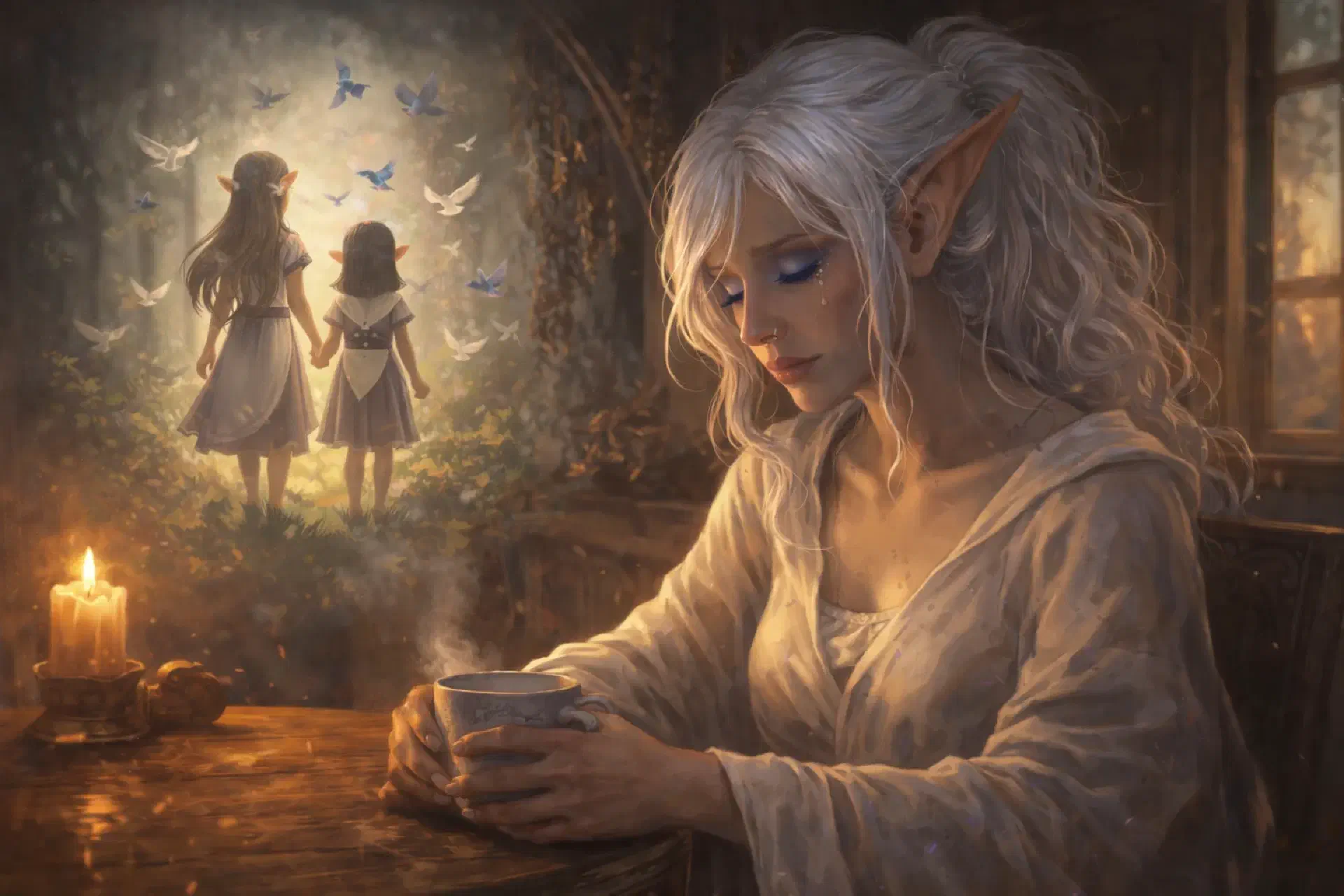
Calantheese stood beside my chair with a freshly brewed porcelain teapot and a clean ceramic cup. Steam rose in fragrant tendrils, smelling of roasted chamomile, silverleaf, and honey.
She poured the cup full of golden-amber liquid. “Drink it,” Cali said quietly.
“I usually wait,” I murmured. “Cold tea is… safe. It doesn’t ask you to be there when it’s poured.”
“Cold tea is what you drink when you think you don’t deserve the time it takes to sit down,” Cali said gently, her voice dropping to a rare, warm tenderness. “You spent eighteen hundred years running ahead of the hurt, Reyneese. You built shields so you wouldn’t feel the hit. You compressed your memories so you wouldn’t drown in the names.”
She tapped the wooden table with her knuckles. “You’re home now. The shields are holding. Drink your damn tea while it’s hot.”
My fingers reached out. The ceramic was warm against my palms—comforting, solid, real.
I lifted the cup and took a slow, deep sip.
The warmth hit my tongue, sinking deep into the old, frozen layers where centuries of compressed grief had lived in silence. It didn’t burn. It thawed.
A single tear tracked down my cheek, hot and unbidden. Across the table, Vyrneese smiled, Avelreese raised her cider mug, Zyneese nodded softly, and Lulu beamed like the morning sun.
For the first time in eighteen hundred years, I finished the cup before it went cold.
IV. The Shadow on the Rooftop #
Midnight fell over Valdrakken.
The house grew still. In the basement, the OC-91 Chariot rested silently beneath clean tarps. Upstairs, the quiet breathing of my sleeping sisters filled the hallways.
I stood on the second-floor balcony, wrapped in a thick wool blanket, looking out over the moonlit spires.
Then, across the street.
Three hundred yards away, perched upon the carved gargoyle of an ancient stone bell-tower, a silhouette stood motionless against the silver stars.
A night elf. Slender, athletic, draped in dark leather harnesses. An asymmetrical bob of pale silver hair stirring in the breeze. Twin longblades sheathed across her back. Over her eyes, a tight dark blindfold.
And beneath the cloth, two pinpricks of emerald fel-fire flickered in the darkness—unsteady, searching, locked directly onto the warm amber glow of our townhouse windows.
A faint sensory memory flashed through my mind—an ancient Thalassian melody, eighteen centuries old, sung by a voice that sounded like childhood laughter under an autumn sun.
The figure tilted her head, as if listening across the distance. Then, with fluid grace, she dropped into the misty alleyways below, vanishing into the sleeping city.
I did not reach for my staff. My hands did not tremble.
Beside me, the second cup of chamomile tea sat in its saucer, steam still curling softly toward the stars.
The tea was warm. The house was safe.
And for the first time in seventeen hundred years, I was ready for whatever the past had left behind.
Gallery #


Follow the Warband on Ko-fi
Get notified on new story chapters, character art drops, and collectible card prints.