Market Day #
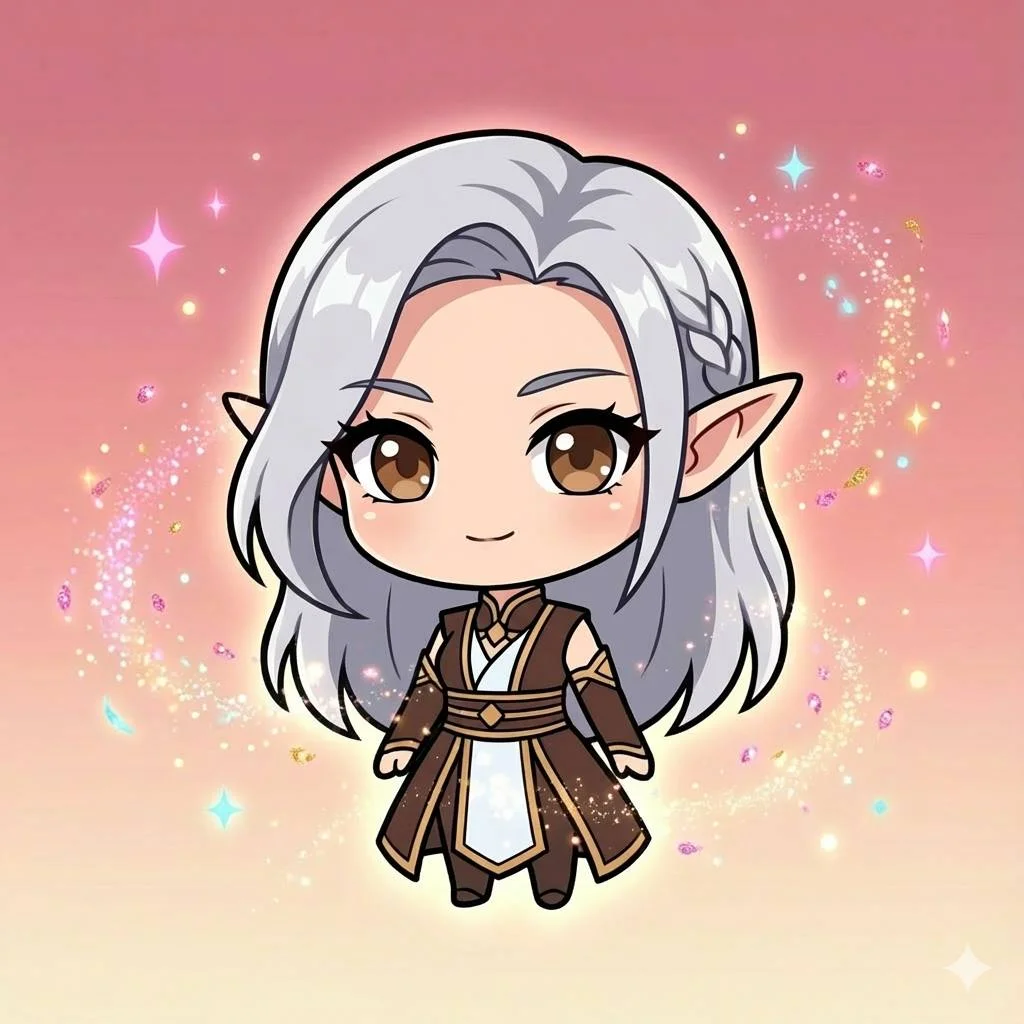
The market was busy — festival busy, the kind where you can’t walk three steps without someone trying to sell you something you don’t need and will probably buy anyway. I was there for supplies. Herbs. Engineering components. The small brass fittings Cali had asked me to pick up — “the ones with the hex sockets, not the round ones, the round ones explode” — and I was trying very hard to focus on my list and not on the vague, unplaceable unease that had been following me all morning.
Some days you wake up and something feels off. Not wrong, exactly. Just — off. Like a note played slightly flat. Like a door you forgot to close. Like someone you used to know is thinking about you, somewhere, with an intensity that crosses distance.
I ignored it. I was getting very good at ignoring things. It was, as Cali would say, one of my less useful skills.
The crowd ahead of me was thickening. Cheering. Applause. Someone shouted something about a demon hunter, and despite myself — despite the list, despite the hex sockets, despite the unease — I moved closer.
The Performance #
She was in the center of the square, and she was magnificent.
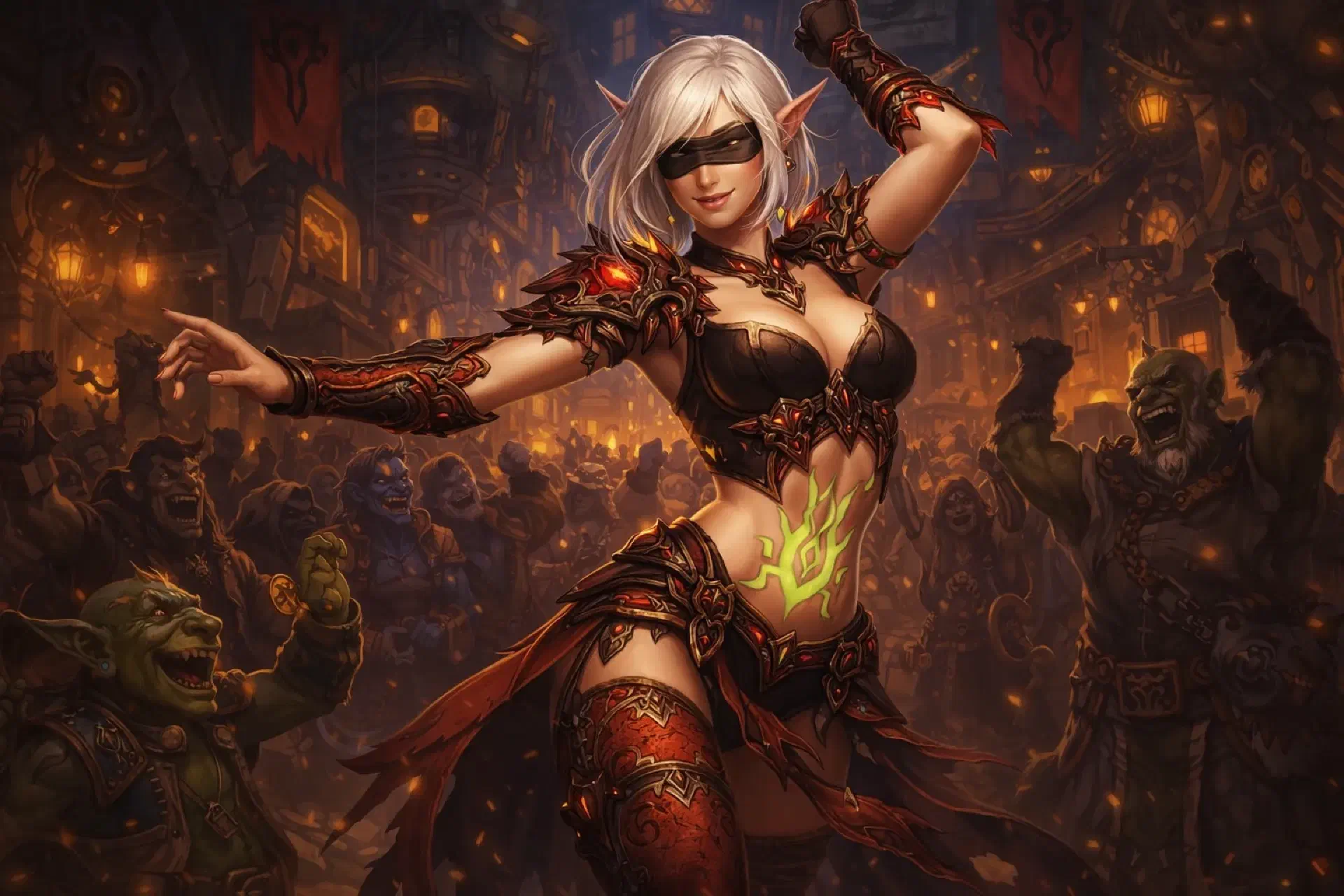
A night elf woman — blindfolded, twin warglaives spinning in patterns that were less combat and more calligraphy. Every movement precise. Every strike intentional. She moved like someone who had turned violence into an art form and was now performing it for spare change. The crowd loved her. Coins landed at her feet. She collected them without breaking rhythm, without acknowledging anyone, a predator doing tricks for an audience that didn’t understand what they were watching.
Something about the way she moved pulled at me. Not recognition — nothing as clear as that. More like the echo of recognition. The shape of something I used to know, compressed somewhere deep in memory, surfacing now only as a feeling.
She was very good. She was also, I realized with the part of my brain that had survived eighteen hundred years of trouble, very angry. The performance was beautiful, but the beauty was edged. Every strike was aimed at something invisible. Every spin was a conversation with someone who wasn’t there.
The music stopped. The crowd applauded. And the demon hunter — still blindfolded, still breathing hard, still radiating that controlled fury — turned her head directly toward me.
I hadn’t made a sound. I was in the third row of spectators, obscured by a very tall tauren and a gnome on his shoulders. There was no reason for her to know I was there.
She knew I was there.
The Approach #
She moved through the crowd the way a blade moves through water — the crowd parting without quite understanding why. The blindfold made it more unsettling, not less. She couldn’t see me. She didn’t need to. Something else was guiding her. Something that recognized me the way a compass recognizes north.
She stopped directly in front of me. Close enough that I could see the fel-green glow seeping around the edges of the blindfold. Close enough that I could smell smoke and something sharper — ozone, maybe, or the particular scent of demon magic that never quite washes out.
“Hello, Reyneese.”
My name. In her mouth. Delivered like a verdict.
I should have run. I should have shielded. I should have done any of the things eighteen hundred years of survival had taught me to do when a predator knows your name. Instead, I did the stupidest possible thing.
“Do I know you?”
She smiled. It was not a nice smile. It was the smile of someone who had been waiting a very long time to be asked exactly that question.
“You don’t remember me.” She said it like she was savoring it. “How perfect. How absolutely, utterly perfect.”
“I’m sorry — I meet a lot of people—”
“Seventeen hundred years.” Her voice dropped. The crowd noise seemed to fall away. “Seventeen hundred years, and you compressed me into nothing. I was your family. And you forgot my face.”
The word landed in my chest like a stone. Family. I didn’t remember her. But somewhere deep in the compressed layers of seventeen centuries, something stirred. Something that knew her voice. Something that recognized the particular angle of her jaw, the cadence of her breathing, the way she held her warglaives like extensions of her arms.
Something that was terrified.
The Attack #
Her hand moved faster than I could track. A chain — where had the chain come from? — wrapped around my wrist.
“You forgot me,” she said. “Let me remind you what that feels like.”
She yanked. I stumbled. The crowd scattered. And then I was airborne — lifted, spun, flung backward by demonic strength into a market stall that exploded into splinters and vegetables and the particular humiliation of being publicly thrown through someone’s produce display.
I lay in the wreckage, dazed, covered in what I would later identify as cabbages, and looked up at the woman who had just attacked me in front of half the city.
“Who,” I managed, “are you?”
She crouched. Massive wings — fel-green, tattered, terrifying and beautiful — erupted from her back. She launched upward, hovering above the chaos like something out of a nightmare the Light couldn’t reach.
“You found balance,” she said, her voice carrying across the square. “You got to heal. You got to be the one people run toward instead of away from. And you forgot everyone who had to become the monster.”
“Wait—”
“Yreneese. My name is Yreneese.” The wings beat once, twice. She was rising. “Not that it matters. You’ll compress this too.”
And then she was gone — over the rooftops, into the grey afternoon sky, her laughter trailing behind her like smoke.
I sat in the cabbages. Someone was screaming. Someone else was helping people up. I couldn’t move. The name was still echoing in my head, bouncing off walls I didn’t know I’d built.
Yreneese.
I didn’t remember her.
But my body did. My hands were shaking. My chest was tight. Something old, something compressed, something I had filed away seventeen centuries ago, was trying to surface.
The Warband #
Lulureese found me first. She burst through the crowd like a very tall, very worried hurricane, checked me for injuries, pulled me out of the vegetables, and didn’t ask a single question until I was upright and mostly stable.
“Who was that?” she asked, which was the right question but also the one I couldn’t answer.
“I don’t know,” I said. “I think… I think we were family. Seventeen hundred years ago. And I forgot her.”
Lulu looked at me. Lulu was good at looking at people — it was one of her gifts, the way she could see past what you were saying to what you meant. “Did you forget on purpose?”
“No. I didn’t even remember there was someone to forget.”
“Then how is that your fault?”
I didn’t have an answer. I’m not sure there is one.
Back at the house, Cali took over. That was another of her gifts: when things stopped making sense, Cali made them into bullet points. “Demon hunter. Claims to be family. Pissed off about being forgotten. Attacked you in public. Flew away.” She looked up from her mental ledger. “Anything else?”
“She said I found balance. That I got to heal.” I was sitting at the kitchen table, tea untouched, Lulu’s hand on my shoulder. “She said she had to become the monster.”
Vyrneese, leaning against the doorframe with Thunderfury humming quietly at her side, spoke for the first time. “She is not wrong.”
Everyone looked at her.
“I was made by Neltharion to be a weapon. People look at me and see a monster. You look at me and see — I am still learning what you see. But it is not monster. This demon hunter — Yreneese — she chose her path the same way you chose yours, Rey. To protect. To be powerful enough. But her path made her frightening. Yours made you approachable. That is not fair. But it is true.”
Zyneese, adjusting her glasses with the particular precision of someone who had been waiting for the right moment to speak, said: “She sees you as a hypocrite. You both reached for darkness. You got to call it balance. She got called a monster. Same motivation. Different branding.”
“That’s…” I started to protest. Stopped. “That’s uncomfortably accurate.”
“Accuracy is my brand,” Zyneese said.
The Decision #
We talked for hours. Cali drew up contingency plans — she had contingency plans for everything, including, I discovered, a file labeled “Rey’s Mysterious Past Finally Catches Up With Her.” Lulu made tea that I actually drank. Vyrneese stood guard by the window, watching the rooftops with the particular focus of someone who had been trained to see threats before they materialized.
Avel, who had been quiet through most of the discussion, finally spoke. “You’re going to have to face her again.”
“I know.”
“When she comes back — and she will come back — what are you going to do?”
I looked around the kitchen. The house. The rules on the wall in Cali’s handwriting. The cold tea that I had somehow managed to drink while it was still warm. The dracthyr warrior who had been a weapon and was learning to be a person. The goblin who pretended not to care and cared more than anyone. The druid whose emotional intelligence was sharper than any blade.
These were my people. This was my family. Not by blood — by Friday evenings and kitchen tables and rules that kept the chaos at bay.
“I’m going to face her,” I said. “Not as the person who forgot her. As the person I am now. And if she wants to talk, we talk. If she wants to fight…” I met Vyrneese’s eyes. “I’m not alone anymore.”
“Damn right,” Cali said.
The Watcher #
Late that night, long after everyone had gone to bed, I stood on the balcony and looked at the stars. The wrong stars — the ones that had been wrong since I left Kalimdor. They didn’t feel wrong anymore. They felt like home.
“Yreneese,” I said to the night. “I don’t remember you yet. But I will. I’m sorry I forgot. I’m sorry it took violence for me to learn your name. I can’t change seventeen hundred years. I can only face what comes next.”
The wind didn’t answer. The wind never does.
But somewhere out there, on a distant rooftop, a blindfolded woman with fel-green eyes was watching the same stars. And she was crying. And she was angry. And she was still, after everything, waiting to be remembered.
Two night elves. Two paths through darkness. One who found balance. One who became the blade.
Same motivation. Different perception.
Both of them right. Both of them wrong. Both of them hurt.
And somehow, against all odds, both of them still alive to face each other.
This story introduces Yreneese as a complex antagonist — not a villain, but someone who made the same sacrifice through a different door and was punished for it in ways Reyneese never was. She will return. The question is: as enemy, as sister, or as something more complicated than either.
Read more: #2: The Shadow’s Origin | #4: Under One Roof, of the House Rules | #5: The Methodical Mind | #7: The Reckoning of Starveil
Follow the Warband on Ko-fi
Get notified on new story chapters, character art drops, and collectible card prints.