
I. The Gap #
The worst departures don’t announce themselves.
Reyneese had expected something — an argument, a door, one clean impossible sentence that would at least give the grief a shape to hold. Instead she was standing in the basement again and Yreneese was looking at her with the careful, considered regard of someone who had already made peace with the shape of this.
It was worse.
Giselle was somewhere in the back. Maren was aboveground. The other women — four signatures now on the charter, and Reyneese had been counting — were not visible, which meant they were present in the way of people who are politely absent from something that is not theirs to witness.
“I know,” Reyneese said.
She had not meant to say it. She had come in with something prepared — careful, precise, the kind of language she used when language mattered. She said I know instead, because that was the true sentence.
“I know you know,” Yreneese said.
The gap between them was not eighteen inches this time. It was something else — not distance, but definition. A border that had finished being drawn.
“Are you well?” Reyneese asked.
“Getting there.”
“Is this—”
“Yes,” Yreneese said. “This is what I’m choosing.”
It was not a rejection. It was not precision applied cruelly. It was simply accurate: this basement, these women, this charter, this was the road Yreneese was on. And the road did not require Reyneese’s arrival to be real.
Reyneese was very old and very practiced at holding things.
She held it.
“Then I’ll know where you are,” she said.
“Yes,” Yreneese said. “You’ll know.”
That was the whole of it.
II. The Walk #
She left without seeing Giselle.
The walk back to camp was not long in terms of streets.
She ran the accounting the way she had always run it — not because it helped exactly, but because accounting was the correct tool for a certain kind of weight. You itemize so the grief stays sorted. So it doesn’t flood.
Shadowlily had what it needed. Five women who had chosen it deliberately. An architect who was already building something larger around the chamber. The right people in the right room with the right purpose.
Yreneese was not taken from anything. Yreneese was in something.
The wanting was still there. She wanted a different road. She wanted the road where the gap never set, where the years before the war had not happened, where sisters were not the kind of thing the world broke apart and left to find each other in basements on different sides of a line neither of them had drawn.
She wanted that.
She decided that wanting and deciding were not the same motion.
Let them walk, she concluded. You can want a different road and still respect the one they took.
The camp fire was visible ahead.
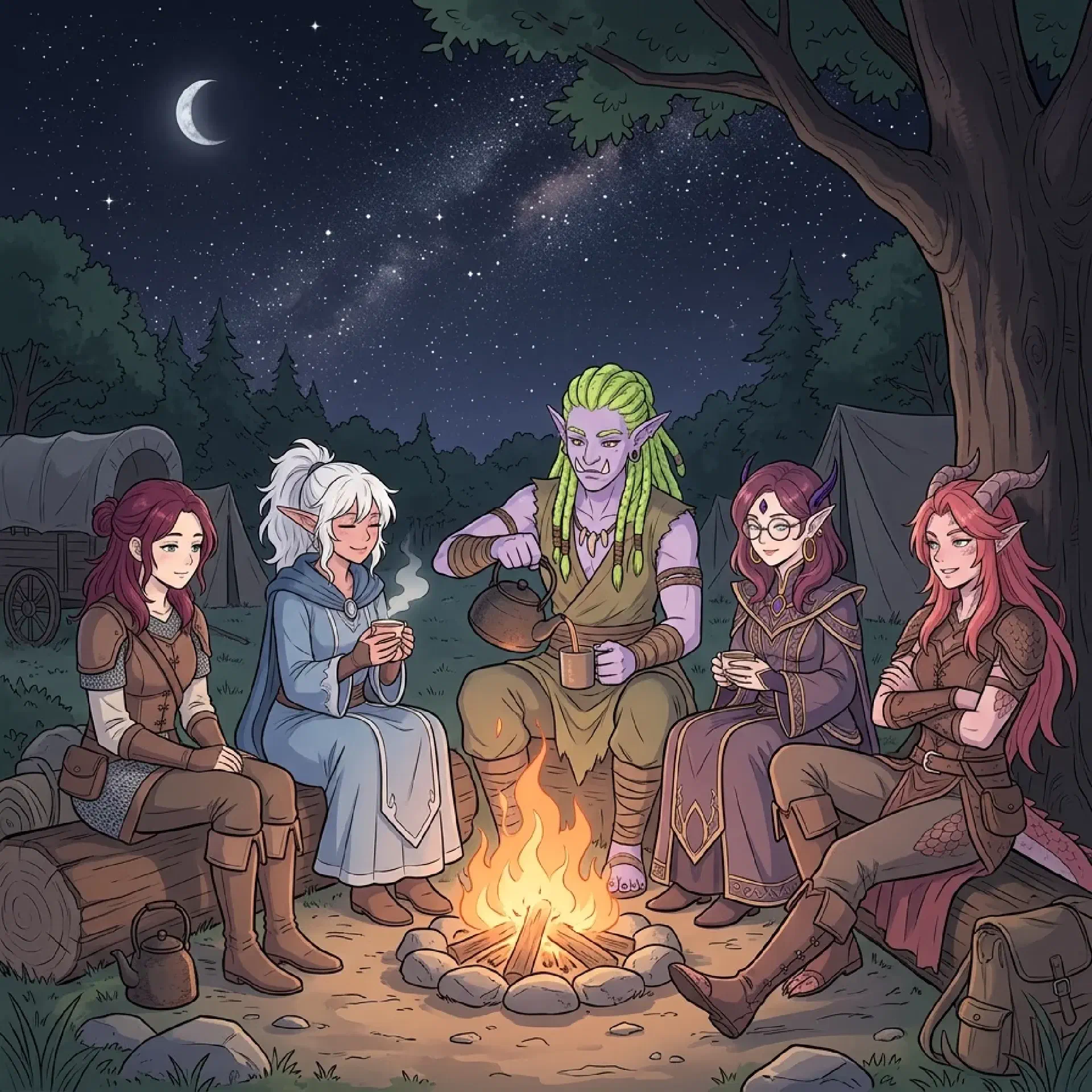
Lulureese was sitting beside it.
III. What Lulureese Said #
She did not ask what had happened.
She read the shape of a person who had just made a hard decision and decided the correct response was presence and not inquiry. She had two cups. She offered one.
Reyneese sat.
For a while there was only the fire, which had the specific quality of a fire that someone has been maintaining with intention.
“I’ve been thinking,” Lulureese said.
“About what.”
She tilted her head toward the camp. Toward the lamp in Zyneese’s tent, which meant filing was happening at an hour that didn’t technically require it. Toward the silhouette of Avelreese doing her evening inventory with the precision of someone who found counting genuinely restful. Toward Vyrneese, sitting against a tree at the camp’s edge with the stillness of someone very old who had learned exactly when stillness was the most useful thing.
“We’ve been so focused on what’s over there,” Lulureese said, “that I don’t think we’ve said out loud what we are to each other.”
Reyneese looked at her.
“What are we to each other.”
Lulureese smiled. Not the small, careful smile of someone managing a difficult situation. The real one, the one she kept for things she meant.
“I think we should find out.”
IV. Five Hold #
It was not a formal thing.
Reyneese called them together by the fire — not with ceremony, but with the quality of someone who had decided to say a thing out loud rather than keep carrying it, and the warband responded in the way of people who had been quietly ready to receive it.
Avelreese looked up from the supply count. Zyneese set down her ledger with the quality of someone who had been half-listening the entire time. Vyrneese turned her attention from the treeline, which was its own kind of presence — the specific, considered weight of someone very ancient choosing to be fully here.
Lulureese made tea.
Not as a performance. She made tea because the kettle was hot and because there were five people at a fire who would benefit from something warm in their hands.
“We’re going to be okay,” Reyneese said.
Not as a comfort offered in the dark. As a decision — the kind she made when the accounting was complete and the conclusion needed saying out loud before it could be acted upon.
Zyneese said: “adjusts glasses Obviously.” She accepted the chamomile without making the face she usually made about chamomile.
Avelreese said: “Good plan.”
Vyrneese said nothing.
She took the cup when it was offered, and drank, and the silence she produced was the specific kind that means I agree and have nothing to add.
Lulureese refilled everyone before they had thought to ask.
Two paths. Two groups of five.
Shadowlily in its basement — purposeful, specific, growing in the way of things that have been planted deliberately and know what they’re growing toward.
Starveil at its fire — five women holding each other with the warmth of people who have been through enough together to know the warmth is worth protecting.
Neither resolved into the other. Both were complete.
The world had not stopped needing fixing.
They were both, in their different ways, working on it.
The fire burned. The kettle had been refilled. They stayed until the evening settled around them like something that had decided they were worth staying for.
Follow the Warband on Ko-fi
Get notified on new story chapters, character art drops, and collectible card prints.