
I. The Room #
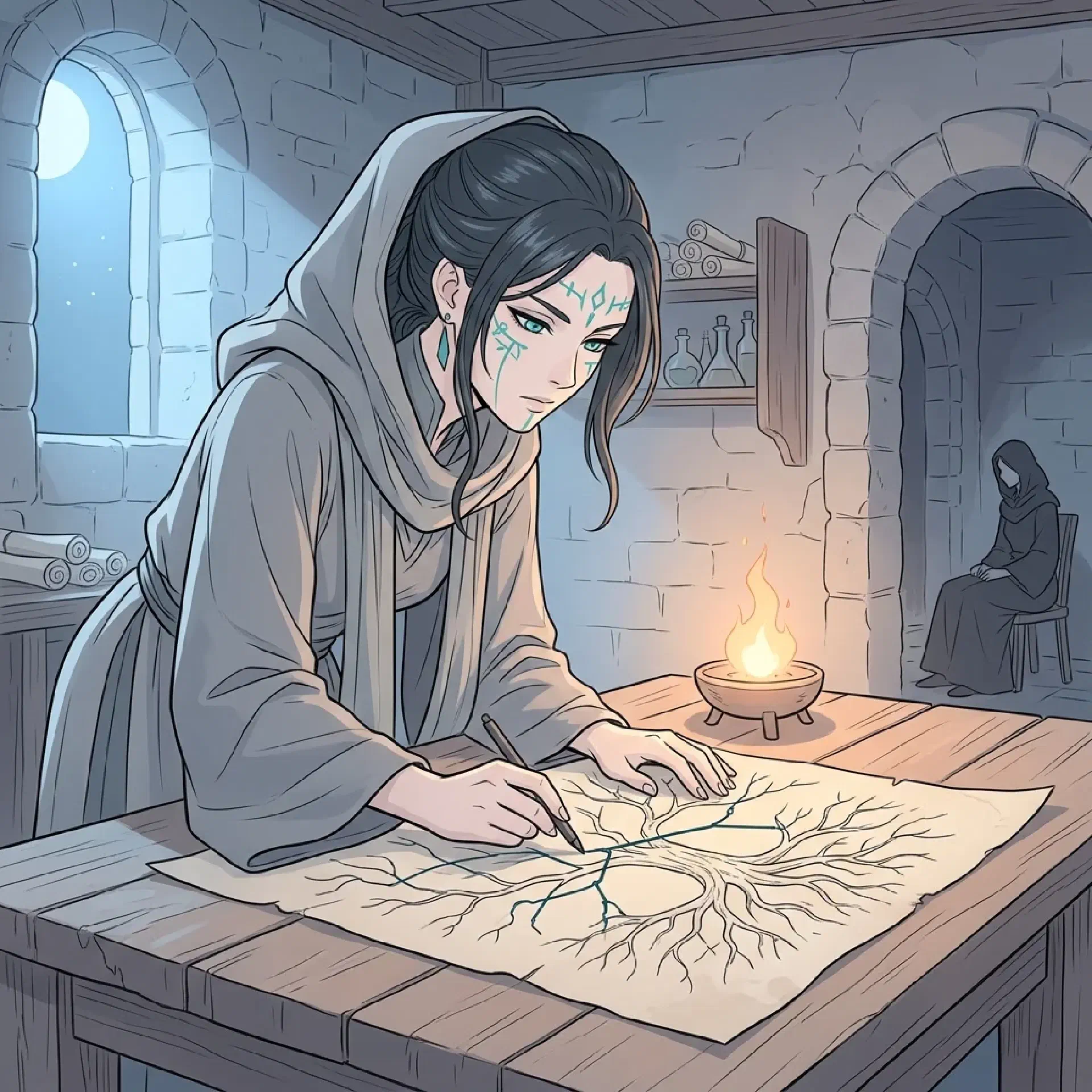
She had been alone in the room for three hours before the calculation was complete.
The lamp stood at her right. She had moved it when she arrived — three inches from where Morrow’s housekeeper kept it, repositioned for the angle the map required. Grove tenders arrange their tools before they work. Everything in its correct position so the hand can read without correcting for bad light.
Morrow was in the next room. She could tell by the quality of the silence — the particular density of it, the way it held a shape. Three hundred years together, and she still knew how Morrow waited.
She drew the map anyway.
Grove tenders map before they touch. The rule was older than her markings, older than her mother’s hands pressing teal into her face at fourteen. You read the damage first. Completely. Before your fingers move.
Four outcomes. She drew them with the patience of someone who had charted corrupted root systems at midnight and waited for the full picture to stop moving.
Both silent: both released. The cooperative outcome — the one that required Morrow to hold, and Morrow to trust that she was holding. Morrow would. She knew this the way she knew corrupted soil: by what was absent in the response. Sixty years of evidence that she was worth trusting.
She sat with that. 이미 결론이 났다 — the conclusion had already been reached. She was only completing the map.
The trait is not the problem. She had been building this argument since the corruption started spreading and the elders stopped listening. The difference between a fearlessness that destroys and one that builds is not the trait itself. The same ruthlessness that cuts out infected root sections without sentiment is the same ruthlessness that burns your own grove records on the way out the door. The same coldness. The same precision. Applied to two entirely different ends.
The difference is what you build.
A surgeon reads a compromised system and removes exactly what needs removing. A grove tender notices void corruption six months before anyone else, files two reports that go nowhere, and watches half the grove die while the council convenes committees. The trait, serving the institution, producing nothing. The trait, freed from the institution, saving what remains with fire.
She had already decided which kind she was going to be.
She looked at the four outcomes again.
One speaks, one stays silent: the speaker is released. The silent one carries seven months of consequence for the other’s courage.
Both speak: fifteen months each.
모로우는 의리 있는 사람이다 — Morrow is a person of loyalty. She acknowledged this without sentiment. Morrow would not speak.
나는 어차피 떠난다 — I am leaving regardless. 지배적 전략 — the dominant strategy. Whatever the outcome, she was done with Harandar.
When the game does not repeat, the cooperative outcome is a gift given at your own expense to an institution that already filed your reports and watched the grove die. She had given two. Precisely evidenced. Completely accurate. The council had filed them. Sections seven through twelve had died in sequence.
She did not owe this place Morrow.
She told them everything. Precisely. Correctly. She named Morrow with the same tone she would use to name a compromised section of root — not with cruelty, not with relief. With accuracy.
She did not look through the gap in the door when they opened it.
She filed Morrow’s seven months as acceptable operational cost, the way she filed every cost that could not be undone: completely, once, and then past it. 감내할 수 있는 손실 — an acceptable loss. 이미 된 일이다 — what is done, is done.
II. What She Kept #
It was morning when she left. She had expected night — the clean anonymity of it, the city at a more manageable distance. The proceedings ran long. The door opened onto gray light becoming gold, and she walked out of Harandar into a morning she had not chosen.
The locs caught the light.
She stopped walking for exactly one second. Not from grief — from the fact of it: the pink-magenta still saturated, still precisely the color the grove had pressed into her hair as a covenant, still present in a way the grove itself was not. She had not looked at herself in three days. The locs did not know the grove was dead. They moved in the wind off the hills the way they always had, and the color had not changed, and she stood on the road out of Harandar and let one second pass before she filed this and kept walking.
She carried: those locs, which the grove had chosen and she had not refused. The teal markings her mother’s hands had pressed into her face at fourteen during the consecration ritual — the weight of another person’s hands saying you belong to something, you are somebody’s. The fel knowledge that had saved half the grove and gotten her named a desecrator by the other half.
She also carried the thing that lives in the chest without asking permission.
In the deep language of her people there is a word for it: 한. It does not translate cleanly because what it names is not a single feeling. It is the weight of a wound that was not healed and is not forgotten and is not carried forward because it is useful — it is carried because it is true. The grove died. She had been right about the corruption. Both facts remain equally, permanently true, and the gap between them does not close. 한 is not bitterness. Bitterness is productive — it moves outward, finds targets, wants something to happen. 한 does not want anything. It has already finished wanting. It simply is, the way the dead sections of the grove simply are, every morning, in every morning that comes after.
She had started carrying it the moment she understood that being right and being heard are not the same thing. She had been carrying it since before she had the word.
She burned her records on the way out. Grove marking documents. Her mother’s blessing certification. Every field report filed and ignored. She burned her own institutional existence with the same flat pragmatism she had brought to burning the corrupted grove sections.
Not rage.
맞다 — correct. As punctuation.
She walked until the gates were behind her and the road ahead held nothing but itself, and thought: read the damage first. Completely. Before your fingers move.
She had read it.
Now she moved.
III. Positional Advantage #
Silvermoon was a garden. It just tended different things.
She arrived through the gates in grove-tender leather — the Haranir feathering at the shoulders, brown and druid-adjacent, reading in every city she had passed through as from somewhere green and unhurried. She had the locs, which were impossible to miss and impossible to categorize correctly if you did not know what they meant. She had the teal markings tracing her cheekbones and throat. She looked exactly like what she was: something from underground that had not yet learned the surface had rules.
She spent three days watching before she spoke to anyone. Not hiding. Positioned. A grove tender catalogues damage before touching anything — she applied this to cities the way she applied it to root systems, settling into tea house corners and courtyard edges with the same flat patience she had once given to compromised soil. Where the performed currency moved and where the real currency moved. Which rooms shifted when a particular person entered. What each district needed.
Blood Elves don’t stare. That was the first thing she catalogued. Not-staring at the right person, at the right moment and in the right register, is worth more than a full minute of direct contact. She learned this by watching it happen to herself — the slight pause as she passed, the redirected gaze, the specific performance of not noticing that requires more effort than noticing would have. She registered each instance with the detachment of someone taking soil readings.
What she understood within the first afternoon: Silvermoon ran on 체면 — face. Not pride exactly. The very specific weight of how one is perceived sustaining itself across every interaction, how giving and losing face functions as the actual currency beneath the visible one. She had grown up in Harandar, where face belonged to the grove collectively. Here it belonged entirely to the person. She filed the difference. It was the most important map in the city.
On the second day, a woman with perfect eyelashes and the particular quality of someone who understands exactly what a room can be made to believe found her in a corridor and said: “You have extraordinary bone structure. The rest is just noise. We can fix noise.”
She looked at her for three seconds.
보여줘 — show me.
What followed was an education delivered without sentiment. Haranir hair spines are not cosmetic features — they connect to something older and bodily than any spell she had learned, sensory extensions bound to the same grove attunement that had once let her feel corrupted root systems through six inches of topsoil. Trimming them was not painless. She did it with less visible reaction than most people show trimming a hangnail, and she noted the cost precisely, and she filed it.
The pink-magenta locs: non-negotiable. She said this once. The woman understood immediately.
The teal markings: they stay. They were her mother’s hands on her face at fourteen. Everything above the collar stays exactly as it is.
Everything else was a question of translation.
She approached the wardrobe problem as applied botany. The guild showed her silhouette as social communication, color theory as status grammar, how fabric movement signals intent. She listened to all of it and ran her own framework underneath — a grove tender knows the difference between the crown and the undergrowth. The crown is the highest canopy, the place the eye reaches for first when it enters a space. Everything else exists in relation to it. The eye in any room does the same thing: it moves along lines, reaches for contrast, settles where it is directed.
She stood in front of three bolts of fabric.
Purple. The warlock’s color — she had been wearing it since Harandar, but in the default cut: high-collared, closed, the register of someone who had learned to cover. She had been treating it like armor. Armor, she had decided, was a category error when the goal was translation.
She thought about where a forest draws the eye. She thought about the collarbone as a line — the teal markings beginning their tracework at the base of the throat, tracing upward along the neck, drawing attention from the neckline to the face along a route she could design. She thought about the waist, and the specific quality of contrast between a robe’s fall and the body it moved with: controlled, deliberate, present in a way that said I arranged myself for this room and I know it and I am not hiding either of those facts.
The neckline she chose was low. The V fell exactly to where the tracework of teal began. The waist was exposed.
She looked at herself in the fitting room mirror.
이것이다 — this is it.
Not armor. Not performance. Translation. The grove tender rendered in the language this city could read. The locs framed rather than hidden. The markings treated as design rather than explained away. The purple given a silhouette that said: I know exactly what I am, and I have arranged myself for this room, and neither of those facts is a secret.
She noted, somewhere in the part of her mind that catalogued useful information for later: this principle was transferable. The neckline says nothing to hide. The posture says nothing to fear. You need both, and the architecture of the neckline creates presence by drawing the eye along a predetermined path toward the face — toward the person who already knows where every exit is. There were women who needed to walk into rooms they had not been built for, and this was how you dressed for that work. She filed it. She would find the occasion to pass it along.
On the fourth day she sat in a tea house, and Caldrien surprised her.
Most conversations she could map in three exchanges. What the person needed, which version of themselves they were presenting, what specific form of attention would bind them closest. She had never stopped doing this. It had never felt like a choice. She would sit across a table and feel the map filling in — patiently, completely, with the unhurried attention of a grove tender reading a root system before touching anything — and by the third exchange she knew the architecture.
Caldrien held a position and then complicated it on his own initiative, without prompting, because the complication was more interesting to him than the position. He revised himself mid-sentence. He was more interested in being wrong productively than right efficiently.
She sat with the unfamiliar experience of not knowing where the map was going.
읽어라 — read it. Grove-tender practice applied inward. Read the root system before you touch anything.
Elevated attention. Physical awareness — the particular quality of presence that wants to remain in proximity to this specific source, indefinitely. She knew the research: misattribution of arousal, intellectual stimulation running through the same nervous channels as attraction. She might be confusing the electricity of a genuinely surprising mind for something else. The feeling was not self-explanatory.
She found she was more curious about the experiment than the answer.
The dagger at his belt had a name. Legendary — the kind that entered rooms before its owner did, that people reached for without thinking. She registered it the moment she sat down, felt the pull of it move through her hands, and made no visible sign of either.
아직 아니다 — not yet. Finish mapping.
By the second evening he had mentioned the library. Casually, the way people mention habits so deeply settled they have stopped being impressive. She registered the location. She registered the manuscript series he described, and she recognized it correctly — watched the revision happen in real time, the way his assessment of her recalibrated by a fraction she measured precisely and did not show she had measured.
She chose every position in that library with the care she had once chosen positions in a dying grove at midnight. Where the light fell — the low lamp and the angle it would cast across the collarbone, the way the teal marks would catch it when she turned. Where the exit was. Where the manuscript shelf sat relative to the window, so her hands would be in light when she reached for a spine.
눈치가 있어야 한다 — you must have nunchi. Read the room before the room reads you. Positional advantage is not aggression. It is attention at the level of strategy.
She was never the one being acted upon.
She let him show her the dagger. Reached for it — fingers unhurried, close enough that the movement had committed to landing — and stopped. Let the stopped hand do its work. She had learned in groves that the tool held just short of its purpose creates more tension than the tool used. The thing about to happen is a different force than the thing happening. She kept her hand still and felt the quality of the air between her fingertips and the hilt, and then she looked up at him from exactly that distance — the lamp catching her collarbone, the locs falling forward — and smiled at nothing in particular, and turned toward something else entirely.
She had not arranged the light. She had arranged the position, and the light followed correctly.
The experiment ran through the night. She measured herself against the feeling across repeating rounds, with the same flat patience she brought to any long observation — lust diffuses with proximity and satiation; genuine interest compounds; the data at the end of the night remained, inconveniently, inconclusive. She was still observing when he finally went still in the dark.
She lay beside him for eleven minutes.
The ceiling of his quarters was higher than she had expected. Early light touched it first, at the edges, a thin line she watched spread toward the center while she lay completely still with the quality of stillness she had practiced in groves at dawn — before you announce yourself, before you touch anything, the grove tells you what you need to know, if you are quiet enough to hear it.
The file was staying open.
She rose, took the book from the third shelf — she had identified it from the spine when he’d turned to face the window — and left him the lamp.
IV. The Architecture of Want #
The street outside his building was empty.
She stood in it with the book under her arm and the early light coming sideways through the gap between buildings — the same quality of light she had watched touch his ceiling from a distance of eleven minutes. Her locs caught it. At this hour, pink-magenta looked almost like something living, which it had been, once, and which she did not currently have time to think about.
She opened the book.
The Architecture of Want: A Practitioner’s Framework for Channeling Desire as Force.
Desire is not feeling. Feeling is diffused light — it illuminates everything equally and therefore nothing with force. Desire, constructed with single-pointed clarity, given architecture and lines of force and specific target and specific pressure, becomes the most reliable channel any practitioner possesses.
She read the sentence twice.
The practitioner does not simply want. The practitioner builds wanting: defines the object, sustains the pressure, removes every competing pull until only the original channel remains. And then — more usefully still — reads that same construction in others. For the want of someone well-observed is the most reliable map of their behavior that exists. It does not lie. It cannot be performed away. It is the root system beneath every surface they will ever show you.
She closed the book.
She had been doing this for five hundred years. Corrupted root systems. Institutional reports filed and ignored. Loyalty structures with known load-bearing failures. The seventeen reactions she had catalogued in her first assembled walk across a Silvermoon room, and the three she had decided were worth developing. The dagger she had not touched. The eleven minutes on a ceiling. The entire time she had been mapping want as architecture — reading the point where it would move under pressure, applying force at that point with specific measured precision, reading the whole system before she touched any of it.
She had not had the vocabulary for it. She had not had the framework that would let her build it deliberately, at scale, using someone else’s desire as the channel instead of her own.
눈치는 결국 이것이다 — this is what nunchi is, in the end. Not the reading of a room for survival. The reading of a room as a system. Every person in it with their want running beneath the surface like a root system — legible, if you are patient enough to map it before you touch anything.
욕망의 구조 — the architecture of desire. This is what she had been building toward.
She looked up.
Silvermoon was waking around her — the first servants on errands, the first carts on the street, the day beginning its performance. She stood in the middle of it with the book under her arm and the locs her dead grove had given her moving in the early air, wearing purple with the neckline that said I arranged myself for this room, and felt something she identified after a moment as satisfaction. Clean. Precise. The specific quality of a map completed correctly.
She was still carrying 한. She would always carry it. The grove died, and she had been right, and both facts remained equally true and the gap between them still did not close — and she had decided, at some point between the burning of her records and the road out of Harandar, that she was going to become the kind of person who could carry that weight and still choose exactly what she tended next.
She walked back through Silvermoon’s gates.
She was still thinking about the experiment.
That file remained open.
Follow the Warband on Ko-fi
Get notified on new story chapters, character art drops, and collectible card prints.