
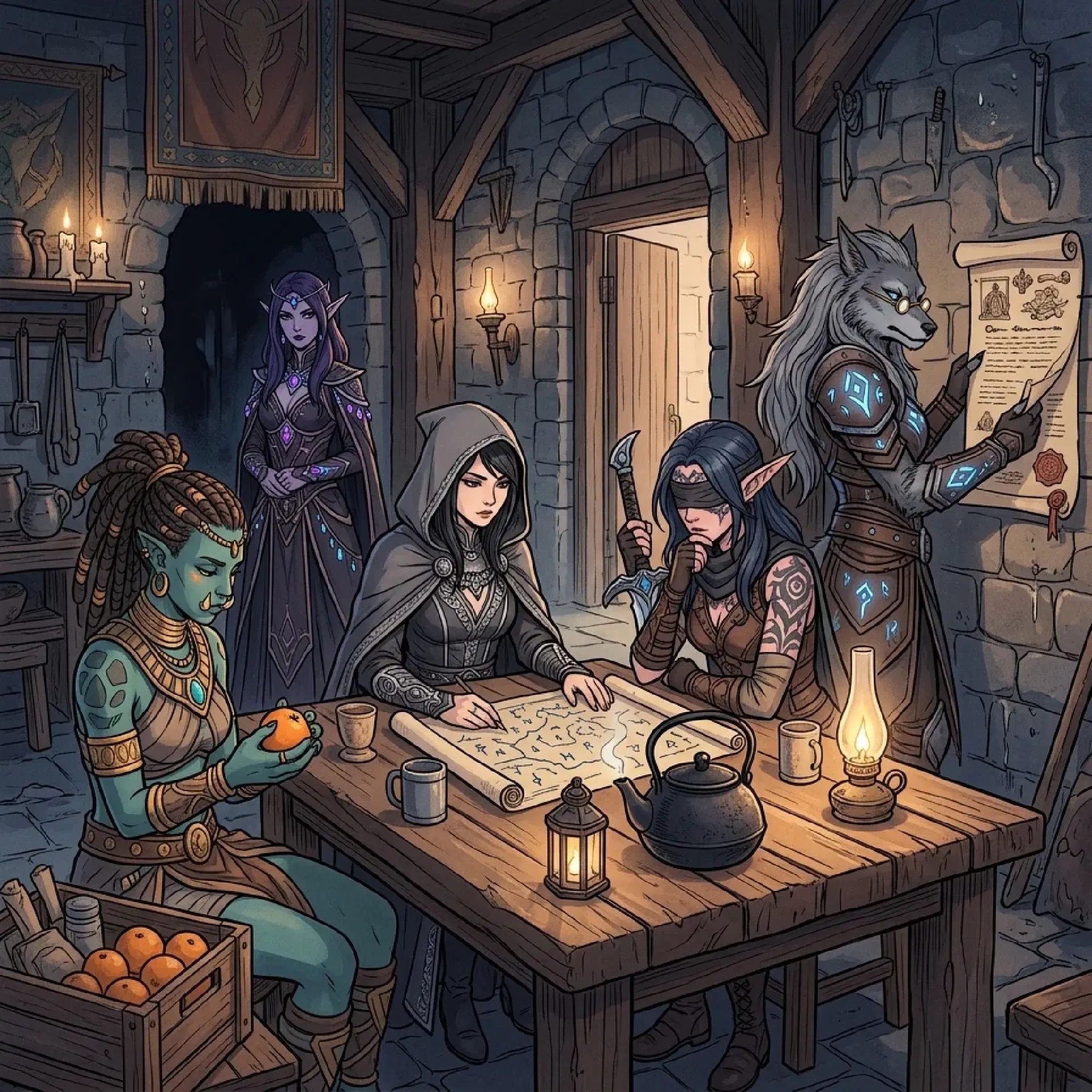
I. The Tending #
Yreneese was awake before Giselle checked.
She had that quality — a demon hunter’s instinct for wakefulness at the wrong hours, or the right ones, depending on how long the captivity had been and how little the body had learned to trust sleep again.
Giselle said nothing. She took the empty cup from the floor, refilled it, and set it back within reach. Then she sat down on the opposite side of the room with her own cup and a length of chain she’d been meaning to repair.
The chain did not particularly need mending.
“You don’t have to watch me,” Yreneese said.
“I know,” Giselle said. “I’m mending.”
Yreneese looked at the charter on the wall. The white lilies still in their jar, still fresh because Maren kept changing the water. The line at the bottom she had read a dozen times now.
For the girls who bloom in poisoned soil.
“The world is broken,” Yreneese said.
“Yes.” Giselle did not look up from the chain. “So we start here.”
It was not an argument. It was not optimism. It was the most functional sentence Yreneese had heard since she was carried through the door, and she filed it the way you file things you will need again.
That was the shape of those first weeks. Giselle tended. Yreneese recovered, which is a word that describes a great deal more than it promises. Maren moved around both of them with the particular competence of a twelve-year-old who had decided that competence was the best available armour.
The world outside had not stopped being broken.
But they started here.
II. The Architect Returns #
Hiyorieese was not dramatic about the things she had already planned.
She arrived on a Tuesday, which was not coincidence — Tuesdays were for arrivals that were slightly more casual than the thing required, and Hiyori knew this and used it. She knocked. She waited.
Giselle opened the door. They looked at each other with the quality of two people who had already concluded one argument and were now determining whether to start the next.
“Come in,” Giselle said.
She did.
Yreneese looked up from the bench where she was working the circulation back into her feet, saw Hiyori, and produced an expression that contained several things at once. Not surprise. Recognition. The specific kind that arrives when a person you have correctly assessed finally appears in a new room and confirms the assessment.
“You planned this,” Yreneese said.
“Parts of it,” Hiyori said.
She sat. She explained what she had come to explain — the outer structure, the way shelter without supply chains was eventually weather, the way Shadowlily was right and correct and insufficient by itself if the intention was anything larger than a good basement. Not an empire. An architecture. Something that scaled without losing the thing at its center.
Giselle listened. She did not like all of it. She trusted the analysis anyway, because she had met enough architects to know the difference between a person describing a building and a person describing a takeover.
“You want to build something around this,” Giselle said.
“I want to show you what grows from this if it’s given the right frame.”
“You’ll tell me when I need to know things.”
“Yes.”
“And not before.”
“Obviously.”
Yreneese looked between them for a moment, then went back to her feet with the quality of someone who had filed the relevant information and intended to be present for whatever came next.
The charter gained a second context that afternoon. Not a new signature. Something harder to write down: a direction.
III. The One Who Was Already There #
The supplies had been arriving for three weeks before Giselle acknowledged them.
Correct supplies. The exact things needed, in the quantities required, left in places that suggested whoever was leaving them had studied the space. Lamp oil when the lamp ran low. Specific salve for demon-hunter scar tissue. Dried citrus that was not glamorous but prevented things that were difficult to treat in a basement without a proper infirmary.
She knew it was not random. She had not said so.
One evening she was in the corridor when the crate arrived, and Shiyaorieese was there when she turned around. Not explaining herself. Simply present in the way of someone who had stopped pretending she wasn’t.
Giselle looked at her for three seconds, which was long enough to complete the accounting.
“You’re invited,” she said.
Not you can join. Not would you like to. Invited — as in, the door had already been open and someone had now said so formally.
Shiya was quiet for a moment.
“I’ll need to know what you need,” she said.
“You seem to already.”
“I’ll need you to tell me anyway.”
Giselle almost smiled. “Fair.”
Shiya signed the charter that evening. She stood in front of it for a long moment, reading the words she already knew, and then wrote her name with the care of someone who had made careful things look effortless for a very long time and was not, for once, trying to.
Maren changed the water in the lily jar the next morning without being asked.
IV. The One from the Cold #
The building smelled wrong to Kiyareese.
Not wrong like danger — wrong like something that needed something. She had been trading along the district, which was where late-season supply chains terminated and where the kind of client who needed the other kind of contract also came looking for her. Both things were true of her. She kept them in separate ledgers.
She noticed the building the way she noticed anything worth noticing: without making a production of it. Death knights inside, by the fel and the cold-management habits visible in the lower window. Not wealthy. Not well-supplied. Cold, specifically.
She left things at the door. Blankets — good ones. Salted provisions. A crate of oranges, because scurvy was genuinely a problem among undead who forgot they still had connective tissue and nobody ever addressed it until it was already difficult.
She turned to go.
“You could come in,” said a voice from the window above.
Kiyareese stopped.
A death knight, watching with the quality of someone who had been watching for a while and had decided to stop being quiet about it.
“I trade,” Kiyareese said. “And I take contracts. The cold kind.”
“I know.”
“Both.”
“I know that too.”
She looked at the crate of oranges on the doorstep.
“The kettle’s on,” Giselle said.
She came in. She drank the tea. She made a correct assessment of the space and the women in it — the demon hunter healing in the corner, the operative who occupied her chair with too much deliberate stillness, the architect who had already assessed Kiya by the time she sat down. They looked at each other once, with the quality of people who recognize a category they belong to, and did not make it a conversation.
Maren offered Kiyareese an orange.
Kiyareese accepted it.
By the end of the evening she had not agreed to anything in particular, and the charter on the wall had five names.
V. Five, and Enough #
Nobody made a speech.
This was correct. Shadowlily was not the kind of thing that benefited from a speech. It benefited from the kettle staying on and Maren’s habit of changing the flowers and the particular quality of five women in a basement who had each arrived through different doors and found themselves in the same room.
Giselleese. Yreneese. Hiyorieese. Shiyaorieese. Ninyreese.
Five names on a charter written for the girls who bloom in poisoned soil.
Hiyori looked at what she had arranged and said nothing about it. Shiya occupied her corner with the practiced presence of someone who had spent a long time being invisible and had recently, quietly, stopped. Kiya turned an orange end over end in one hand, which meant she was thinking about something that was not the orange.
Yreneese looked at Giselle.
Giselle looked at the charter.
Below the five names, the space was still blank. Still room. There was always still room.
The world outside had not stopped being broken.
Five lamps in a basement had not fixed it.
But the foundation had names now. And the next layer already had an architect, and a direction, and a season to grow in.
That was enough.
Follow the Warband on Ko-fi
Get notified on new story chapters, character art drops, and collectible card prints.