I. What Remained #
The Forbidden Reach was breaking apart.
Not quickly — not all at once — but in the way old things end: stone by stone, with enormous patience and no apology. Vyrneese felt it before she opened her eyes. A deep subterranean groan, the language of pressured rock, the earth saying enough the way it had always said enough, in the only voice it knew.
She opened her eyes.
The ceiling above her was cracked. Light came through — actual sunlight, pale and disorienting — from a fissure that hadn’t been there when she lay down. Or when she was put down. Or however it had happened. She had never been able to decide which verb was true.
She sat up.
Her body remembered everything her mind was still sorting through. Muscle memory in twenty thousand years of stored potential, compressed into dormant form, now released: she was upright before she was fully conscious. Hands on the floor. Weight distributed. Legs under her. Standing was the first thing she had ever learned and the body did not forget.
The room around her was not a room anymore. It was a ruin with aspirations.
She catalogued what she knew: She was Vyrneese. She was dracthyr. She had been created to protect.
And she had been asleep for — she looked at the ceiling, at the crack, at the way the stone had aged and settled and shifted — a very long time.
She walked to the fissure. Pulled herself through. The rock bit at her hands and she noted it: pain. Real pain. She was awake.
Outside, the sky was the wrong color. Not wrong-wrong — it was blue, normal, a sky like any sky. But the light came from a different angle than she remembered. The constellations would be wrong too. She knew this without checking.
Twenty thousand years of sleep, and the stars don’t wait.
She stood on the cliff edge of the Forbidden Reach and looked out at an ocean that hadn’t been there before. Somewhere under that water was land she knew. Somewhere.
She was a warrior. She needed a weapon.
The rest she would figure out later.
II. Tasharyn’s Voice #
There had been a woman named Tasharyn.
Not a human woman — dracthyr, like Vyrneese, but older in the way of warriors who’ve seen more campaigns than their years should carry. Her scales were deeper red, almost garnet, and she wore the kind of calm that comes from having been afraid enough times that it stops being interesting.
Tasharyn had been the one to show Vyrneese how to hold a shield correctly. Not Neltharion — he showed the principles. Tasharyn showed the specifics. Angle. Weight distribution. The shield is not a wall. The shield is a conversation. You’re asking the hit to go somewhere else.
They had run drills together in the Reach for years. Two dracthyr warriors, younger and older, the kind of pairing that happens naturally when one person is very good at something and another person wants badly to be.
Vyrneese could not remember what happened to Tasharyn before the sleep. The memory stopped. A wall.
But she remembered the last thing Tasharyn had said to her — not in the final moments, because she couldn’t reach those — but sometime before. An idle conversation. Tasharyn, sharpening something, not looking up:
There is a blade. Called Thunderfury. Made from the essence of Thunderaan the Windseeker — bound to lightning, to wind, to the kind of power that has a name because it has to be named or it won’t stay contained. I have never held it. I’ve only read of it. But I know what it is.
Vyrneese had asked why she was telling her.
Because you’re the kind of warrior who needs a weapon that means something. Not just a weapon that works. Something that you had to become worthy of.
She had said it easily. Offhand. The way you say things you believe without needing to explain them.
Vyrneese stood on the broken cliff of the Forbidden Reach with the wrong sun above her and the wrong stars waiting for dark and that voice in her head, twenty thousand years preserved in amber, still perfectly clear:
Find a blade worth wielding. Then you’ll know what you are.
She didn’t know where to start.
She started anyway.
III. The Long Way #
The world had moved without her.
She spent the first months learning geography by walking it — literally, on foot, in visage form because dracthyr drew too many eyes in places that weren’t ready for them. The landmass was wrong. There were two continents where she remembered one. There were cities where she remembered forests. There were forests where she remembered cities.
She got lost constantly.
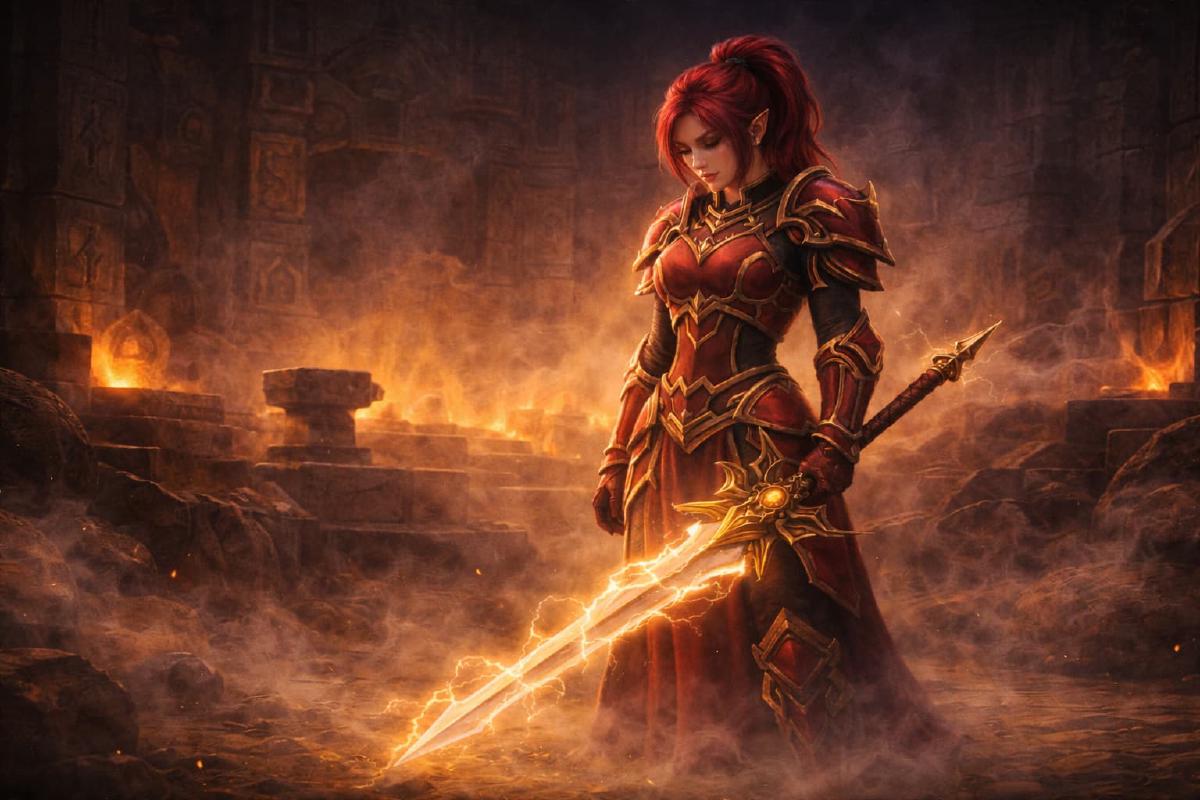
She asked for directions from strangers who looked at her — at the baby-faced young woman with the red-pink hair pulled back in a loose ponytail asking confidently about roads to “the place where fire lives underground, I think near the center-south of the first continent, the large molten structure, you must know it” — and found their confusion instructive.
She learned the name: Molten Core. She learned what it was: a raid. She learned what that meant: many people, going in together, to kill things that would otherwise kill them.
Can we just go in alone? she had asked a hunter outside the entrance who was assembling a group.
He had looked at her for a long moment. “You can try.”
She tried.
She was not successful the first time.
Or the seventh.
By the fourteenth attempt — having figured out, through extensive empirical testing, which enemies she could survive alone and which she could not — she had developed a system. You couldn’t clear Molten Core solo. But you could run it systematically, with the right group, week after week, until what you needed dropped.
She needed the bindings.
She waited.
She fought.
She trained between runs in whatever empty space she could find — fields, clearings, the stone floors of inns whose proprietors had given up asking her to stop — because fighting is what she knew how to do and doing it helped her understand what she still didn’t know. She was good. She had always been good. Neltharion had made her good. But good wasn’t the same as whole, and she was beginning to feel the distance between the two.
The first binding dropped on the thirty-first run.
She held it in both hands for a long time, standing in the heat of Molten Core with boss bodies cooling around her and her groupmates looting and talking and doing the ordinary things people do after a fight. She held the binding.
One.
IV. The Arcanite Problem #
The second binding came eight weeks later.
She stood at the foot of the forge in Ironforge — enormous, old, lit by dwarf-fire that smelled different from dracthyr-fire but served the same purpose — and spread out everything she had assembled on the stone floor. The bindings. The elementium. The essence. The globe of water. The core of earth. The heart of fire. The breath of wind.
She had collected them with the systematic patience of someone who has never learned to find a task tedious because she has never had enough tasks to develop the preference.
Ten arcanite bars remained.
Arcanite bars could not be bought. Could not be found. Could not be won in combat, extracted from rock, or traded for at most vendors. They had to be made — transmuted — by an alchemist, and alchemists could only transmute one per day, because the process required something the craft called settling time and Vyrneese called inconvenient.
She had been asking around for two weeks.
Most alchemists wanted gold she didn’t have enough of, or favors she wasn’t sure how to provide, or simply weren’t willing to spend ten days of their cooldowns on a dracthyr woman who explained her need by saying “I am assembling a legendary blade for reasons that are personal and require the blade to be specifically this blade.”
She was standing outside an inn in the Wetlands, recalculating, when the night elf sat down next to her on the step.
V. The Priestess #
She hadn’t noticed her approach.
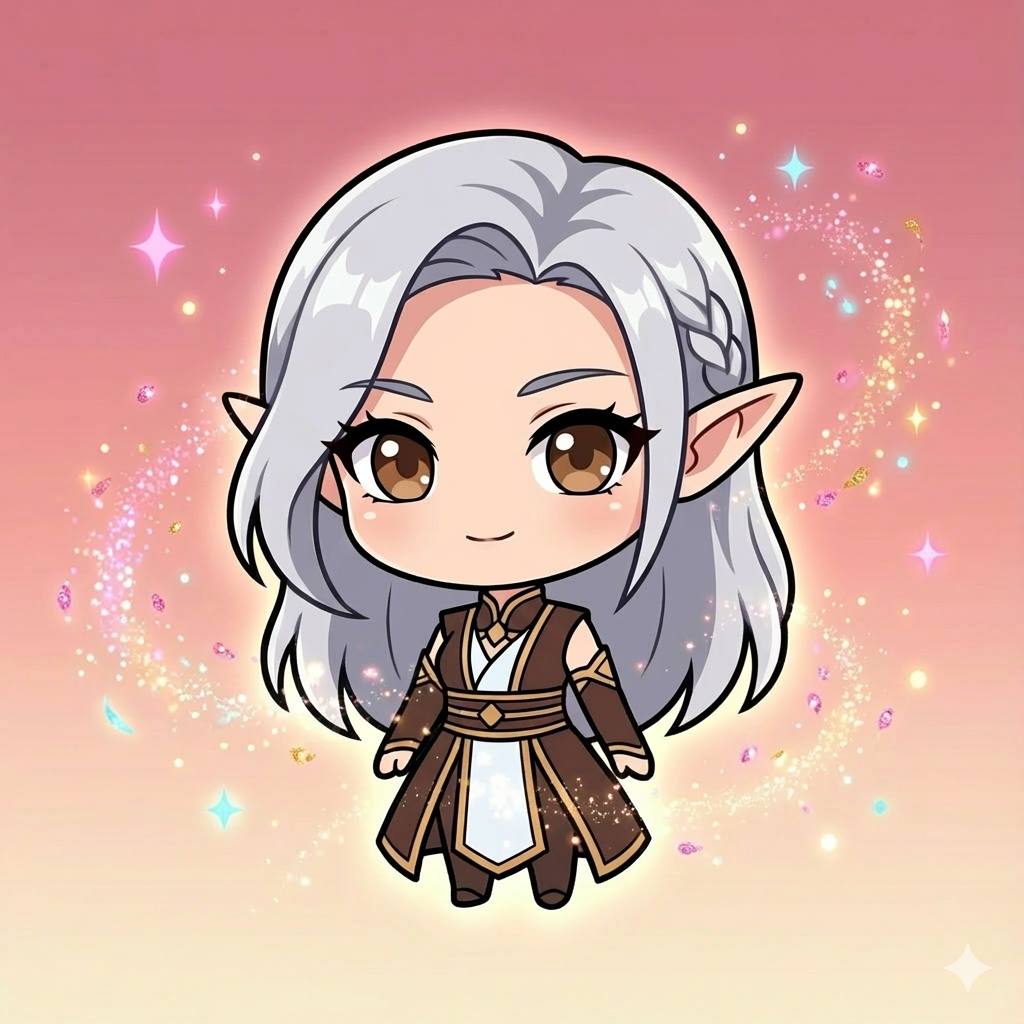
That was strange — Vyrneese noticed most things. But the night elf moved like water moves, without announcing itself, and was simply there: tall, silver-haired, robes that had seen considerable travel, a wooden staff leaning against her knee and a small satchel of herbs at her hip.
She was looking at the forge inventory spread out on Vyrneese’s knees with an expression that was not quite curiosity and not quite recognition but somewhere between them.
“Thunderfury,” she said. Not a question.
“Yes.”
The night elf picked up the breath of wind, turned it over, set it down. Picked up the heart of fire. Set it down. She moved through the components with the slow deliberateness of someone who has learned that quick assessment is almost always wrong.
“You’re missing the arcanite bars.”
“Ten of them.”
“You can’t find an alchemist willing.”
“I have found many alchemists.” Vyrneese did not look up from her inventory. “None of them have wanted to help me.”
“Why do you need this blade specifically?”
Vyrneese considered the question. She was getting better at knowing when questions were genuine versus when they were small talk, which she had learned was a way of talking that meant something different from what it said. This question felt genuine.
“Someone told me to find it,” she said. “Before the sleep. She was a warrior. She said it would mean something.”
“The sleep.”
“I was in stasis for twenty thousand years.” She said it the way she always said it — flatly, because it was simply true — and waited for the flinch that usually followed. “The Forbidden Reach. I am dracthyr. I was made by Neltharion.”
The night elf was quiet for a moment.
“I have seen this world end three times,” she said finally. “And I still don’t quite know how to explain what that is to someone who didn’t. I imagine twenty thousand years is difficult to explain too.”
Vyrneese looked at her for the first time.
The night elf’s eyes were pale blue, luminous in the way of her kind, and carried the particular weight of a very long life — not heaviness, exactly, but mass. The way certain stones have mass you don’t expect from their size.
“You’re old,” Vyrneese said.
“Ten thousand years.” The corner of her mouth moved. “You have me by half.”
“I don’t have those years. I was asleep.”
“And yet you’re here, looking for a blade to stand in the world with.” She settled back against the inn wall. “That seems like a kind of waking up.”
VI. The Transmutation #
Her name was Reyneese.
She had been a herbalist and alchemist for — as she put it — “longer than most civilizations have been having opinions about alchemy.” She was traveling. She was, she said, not yet sure where.
She agreed to do the transmutations.
Not for gold — she waved that off with a gesture that suggested gold was something she thought about approximately as often as she thought about the weather in places she wasn’t currently standing. She did it because, she said, she had watched Vyrneese describe the blade, and the sister who mentioned it, and the thirty-one Molten Core runs, and she had recognized something she described only as “the kind of drive that doesn’t come from ambition.”
“What does it come from?” Vyrneese asked.
“From needing to know something about yourself,” Reyneese said. “The blade isn’t the point. You already know that. You just can’t stop until you’re sure.”
Vyrneese did not answer, because she was not sure that was true, and also was not sure it wasn’t.
The transmutations took ten days.
Reyneese worked in the mornings, in whatever outdoor space they found themselves in — they had moved twice, following no particular logic that Vyrneese could identify — with the same unhurried attention she applied to everything. Arcane crystals and thorium bars becoming something new. The process was quiet. Ritualistic. She did not rush it.
On the tenth morning, she placed the final bar on the stone beside Vyrneese’s hand.
“There,” she said.
Vyrneese picked it up. It was heavier than the others somehow. Or perhaps the same weight, but carried differently now.
“Why did you help me?” Vyrneese asked.
Reyneese looked at her with those old pale eyes.
“Because Tasharyn was right about you,” she said. Then, at Vyrneese’s expression: “I didn’t know her. I just know the type of woman who tells a warrior to find a blade worth finding. She knew what you needed before you did.”
Vyrneese looked at the bar.
“She didn’t survive,” she said. She wasn’t sure why she said it. She didn’t know it was true. She only knew it felt true — the way stone feels true, under her hands, through her palms, the deep knowledge of what is real and what is not.
Reyneese did not offer comfort. She did not say I’m sorry. She said:
“Then find the blade. Don’t stop until you’re holding it. That’s all you owe her.”
VII. Thunderfury #
The forge work took three more weeks.
When it was done — when the blade was fully assembled, the bindings joined, the components given their final form at the high-temperature forge in Ironforge with the help of dwarves who had heard of the quest and showed up, apparently, for the historical significance — she held Thunderfury for the first time.
Lightning moved through it before she moved it. She hadn’t asked it to. It simply did, recognizing something in her hands or her grip or her twenty-thousand-year-old warrior muscle memory that Tasharyn had put there one drill at a time.
The sound it made was not loud. It was certain. The kind of sound that isn’t announcing itself but simply telling you what is true.
She stood in the anvil room with the dwarves watching and the smoke clearing and the lightning settling into the blade like something that had found its way home, and she thought: I am still a weapon. But now I have a weapon.
That was new. That was different. Neltharion had made her a weapon and told her that was her purpose. Now she had chosen a weapon and the choosing had been hers. Tasharyn had known this would happen — had known, or hoped, or both, the way senior warriors sometimes know things they can’t quite explain to the people still learning.
Find a blade worth wielding. Then you’ll know what you are.
What she was: a warrior. Twenty thousand years old. Thirty years lived. Standing in a forge in a city built after she was born, holding a blade made from a wind god’s essence, with the stars in the wrong places and the geography rearranged and one woman’s voice still preserved perfectly in her memory like something the sleep had kept safe for her.
She was here. She had stood up. She had figured out the rest.
She walked out of Ironforge into the grey afternoon.
Reyneese was sitting on the steps outside, herb satchel open, doing something that involved a small knife and a considerable amount of patience.
She didn’t look up. “Was it worth it?”
Vyrneese considered this seriously, the way she considered everything.
“Yes,” she said.
“Good.” Reyneese folded the herb she was working with and tucked it away. “I’m looking for a warband. People worth fighting beside. I haven’t found the right ones yet, but I will.” She finally looked up. “You should come. Whenever you’re ready.”
“I don’t know how to be in a warband,” Vyrneese said. “I was only ever trained alone or in formation.”
“Neither did I, the first time.” She stood, settled her satchel, picked up her staff. “You learned a whole world in thirty years. You’ll manage.”
She walked down the steps and into the city.
Vyrneese stood with Thunderfury in her hand and lightning quiet in the blade and the old familiar question — what am I, what am I, what am I — somewhere in the back of her mind where it had always lived.
But quieter now.
She followed the night elf.
The blade still carries lightning. Vyrneese still carries twenty thousand years. Both are heavier than they look.
She doesn’t tell many people about Tasharyn. But she keeps the name. She figures that’s what you do with the dead — you keep their names until the keeping starts to feel like having.
She’s still figuring out the difference.