
The accounts said the guild was profitable.
The accounts, as always, did not understand irony.
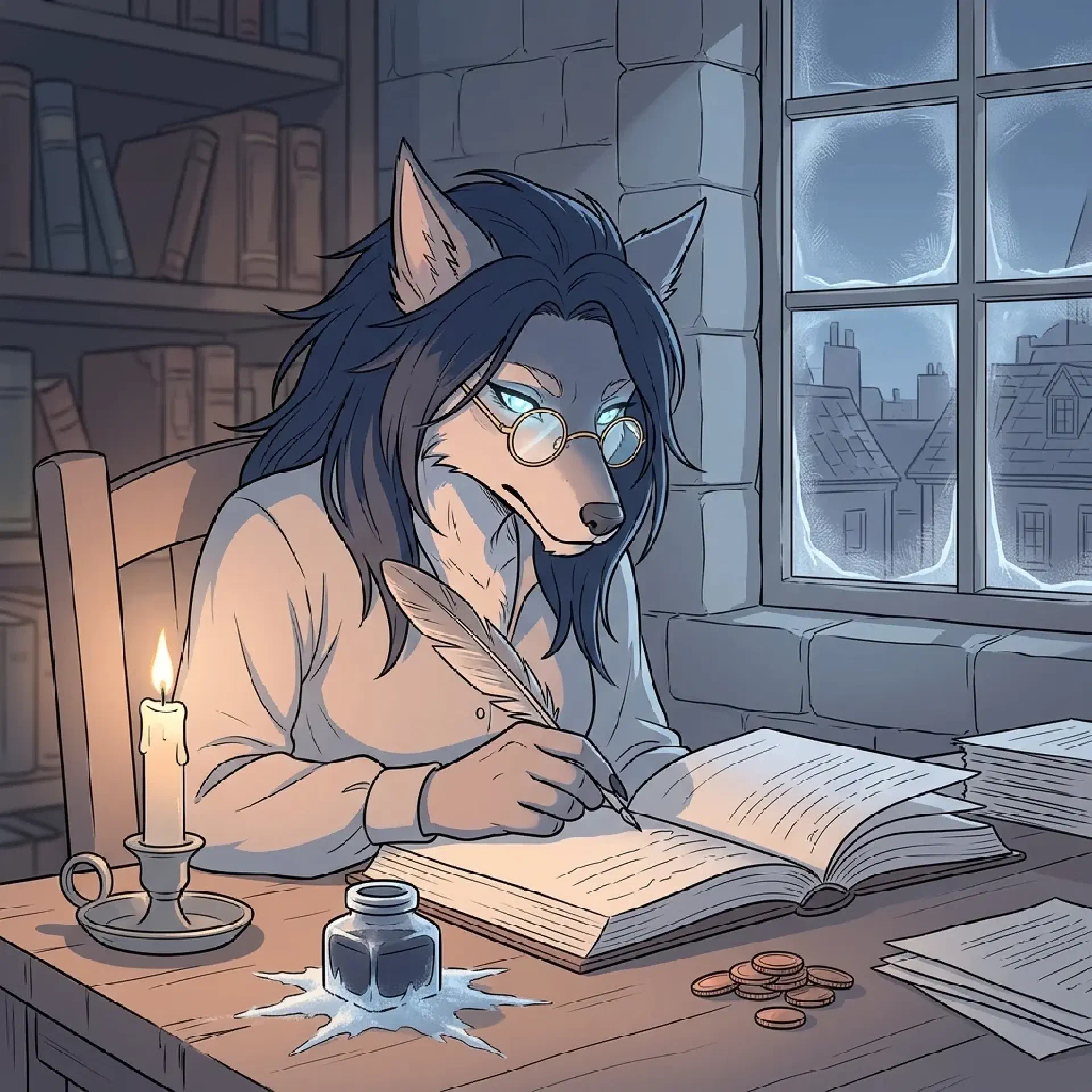
Three in the morning. Frost on the inkwell — her fault. Giselle set down the quill and looked at the name at the top of the ledger. The Gilded Décolletage Co. She had chosen it carefully. The kind of name that made a particular type of person immediately want to go deeper. Into it. Into her. Into what, precisely, was on offer.
She had found this useful as a filter.
There was a sculpture she’d once heard described — a girl carved from marble. Serene. Beautiful. A curtain of glass beads hanging across her face. Behind it: a skull. Scars worked into the body below. The artist had meant this to disturb. It had disturbed everyone who heard the description except Giselle, who had thought only: yes. That’s accurate. The beads are always there. You either look behind them or you don’t. Gilded Décolletage was the same construction. A curtain. A question about what you do next. La calavera siempre está. — The skull is always there. She had picked up the phrase in a Booty Bay dockside tavern from a halfdrunk arcanist who was explaining something entirely different. It had stuck. The point was the same.
She hadn’t needed the sculptor to explain. She had been both things at once for fifteen years — the surface people read, and the skull beneath it.
The type who heard Gilded Décolletage and assumed they understood — assumed there was something to plunder, something soft underneath the polish — showed themselves early. She didn’t keep them.
A new recruit had asked yesterday, sincerely, what the name was about.
She had looked at them for four seconds. Prestige, she’d said. That’s what it means.
They’d nodded. Didn’t understand. Might, eventually.
She’d been that girl once. Before Gilneas. Before Northrend. Before she’d died twice and come back with hands that could still wrap a wound and a body that had stopped relaying everything else — the warmth of a fire, the texture of velvet, whatever apparently happened at the end of a particularly good evening that moved people to say things they regretted in daylight.
She had wanted things, then. Not extraordinary things. Fire that felt warm. Company that didn’t feel like a transaction. The particular quality of another person’s attention when it landed and stayed. She had thought that was attainable. She had been wrong in the ordinary way — the way most people were wrong before the world had time to demonstrate otherwise.
She had believed in the vase. Most people did. The body presents so convincingly — the form, the warmth, the way light moves across certain faces. She had found it persuasive, once.
In the grey months in Northrend, keeping the wounded alive between shifts, she’d read what the dead carried. Prayer texts, mostly. Field manuals. One fraying scroll — no name on it, no provenance — that said something like: desire is salt water. Each swallow promises relief. Each swallow increases thirst. She’d carried that sentence for fifteen years. It had held up.
She had been the vase by then. A worgen body she hadn’t chosen, a death knight body she hadn’t been given. Twice over, rebuilt into something that persisted. The leaking had already happened. Clarity was what remained.
She hadn’t found it depressing. She’d found it clarifying.
She’d thought the women who ran things like this were the problem.
She understood it differently now. The problem was never the cup. It was the thirst — the particular hunger that called itself love or need and was really just the ache of someone who hadn’t understood that the wanting never ends on its own terms. The women who ran things like this at least knew what they were offering. Everyone else was drinking salt water and blaming the cup.
She pulled the ledger back. Totalled the column. Added the shelter intake: four this week. Four names.
She didn’t read the files the night they arrived — too much, always, in those first hours. She read them after a week, when she’d had time to learn whether they startled at doors, whether they ate, whether they cried somewhere they thought no one could hear. The files told her what had happened. The week told her who was still in there.
Four girls who needed the roof to hold.
The guild paid for the roof. El techo se sostiene. — The roof holds. That was the entire metric. Nothing more complicated than that.
Another day, another dollar.
If performing enthusiasm she no longer received was ever required — she thought she probably could. She’d provided stranger services with less.
Service, after all, was the whole architecture.
She turned the page. Kept working.
Follow the Warband on Ko-fi
Get notified on new story chapters, character art drops, and collectible card prints.