
  1. Stories/

Chronicles of Six #3: The Girl Who Said No

Chronicles of Six - This article is part of a series.
Part 3: This Article

I. The Forest Edge
#

Two days after the charter. One day after Maren.

Giselle is out again.

The girl is settled—as settled as a twelve-year-old can be in a moldy basement with a death knight landlord. Maren sleeps fourteen hours at a stretch, eats what Giselle brings, and stares at walls. Giselle recognizes the pattern. Gilneas, after the fall. The body shuts down so the mind can rebuild. Give her time.

But time needs filling. Shadowlily isn’t a guild with one resident and a death knight who pickpockets for grocery money. It needs people. Healers. Hearts. The kind of person who sees broken things and reaches for them instead of stepping around.

The kind of person, Giselle thinks, she is not qualified to be.

She’s qualified to build the building. Someone else needs to be the warmth inside it.

She walks the forest road outside the eastern gate. The displaced families have thinned—the city guard relocated most to temporary shelters in the Dwarven District. The cathedral steps are almost empty. But the forest edge, where the city’s noise fades and the trees take over, is where Giselle goes to think. Dead legs don’t tire. Dead lungs don’t need rest stops. She walks until the walking does what meditation does for the living.

And then she hears it.

Singing.

Not a hymn. Not a battle song. Something formless and warm, like sunlight given a voice—a troll melody, rhythmic, rising and falling with the cadence of someone who sings the way other people breathe.

Giselle follows the sound.


II. The Clearing
#

The clearing is thirty yards off the road, screened by young oaks. A natural bowl in the forest floor, carpeted with moss, dappled with late-morning light filtering through the canopy.

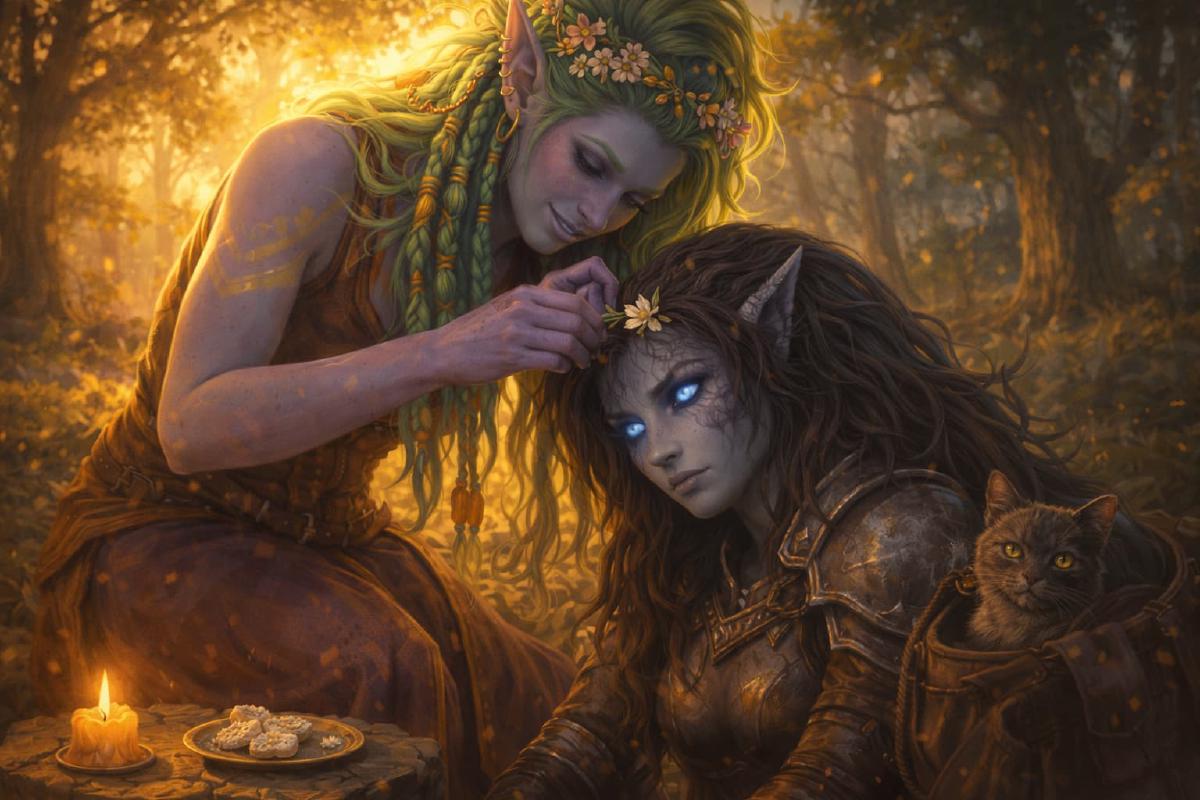
In the center: a troll woman. Tall—very tall, six-four at least—standing straight and proud with no hint of the hunched posture most people associate with trolls. Turquoise skin vivid against the green. Emerald hair wild and thick, decorated with wooden beads and small feathers. Tusks gleaming. Amber eyes bright.

She’s surrounded by animals.

A fox with a burned paw, lying on a bed of moss while the troll wraps it in a poultice. Two songbirds perched on her shoulder, singing along with her melody. A rabbit, half-hidden under a fern, watching with cautious eyes. And a grey cat—patchy, one ear torn, a treated burn on its flank—curled in the troll’s satchel like it’s been there its whole life.

The troll doesn’t notice Giselle. She’s absorbed. Her hands move with druid precision—herb paste, clean binding, a whisper of green magic that sinks into the fox’s paw and makes the animal sigh.

Lulureese (to the fox, gentle): “There. See? Better already. You’re SO brave. You’re the bravest fox.”

The fox licks her hand.

Lulureese: “We’re bonded now!”

The fox seems to accept this.

Giselle watches from the tree line. She’s good at watching—death knight patience, corpse stillness. Most people don’t notice her until she moves. This troll won’t notice her either.

Except the cat does.

The grey cat in the satchel lifts its head. Stares directly at Giselle with enormous amber eyes. Hisses softly.

The troll turns.

And Giselle sees the exact moment Lulureese registers what she’s looking at: a death knight, frost-blackened hands, glowing blue eyes, undead stillness, standing in the shadows of the tree line like something that crawled out of a Scourge nightmare.

Most people flinch.

Most people step back.

Lulureese’s face lights up.

Lulureese: “Oh! HELLO! Are you hurt? Do you need help?”


III. First Contact
#

Giselle steps into the clearing. Slowly. Not because she’s cautious—because this troll just asked a death knight if she needs help, and Giselle needs a moment to process that.

Giselle: “I’m not hurt.”

Lulureese: “Are you sure? You look… cold.”

Giselle: “I’m dead.”

Lulureese (tilts head): “Oh! That’s sad. Are you okay about it?”

Giselle stares.

Nobody has asked her that. Not in eight years of undeath. Not the guards who wave her through with nervous hands. Not the priests who offer purification she doesn’t want. Not the Forsaken who treat her like kin she isn’t.

Are you okay about it?

Giselle: “I’m… managing.”

Lulureese (nods seriously): “Managing is good! Managing is the step before okay. And okay is the step before good. And good is the step before GREAT.” (beams) “I’m Lulureese! This is Cinder!” (holds up the grey cat) “She was in the market when the big demon came. We’re bonded now.”

Giselle: “You were at the market?”

Lulureese: “My warband was! We fought the demon. Well—we fought it a little. Then we flew away on a robot.” (says this like it’s a normal sentence) “I found Cinder in the rubble the next morning. She was so scared. But she’s BRAVE.”

The warband. The priestess. The golden machine.

This troll is part of the group that fought the pit lord.

Giselle files this. Doesn’t react.

Giselle: “You’re healing animals from the attack.”

Lulureese: “Someone has to! The city helps the people. The druids help the trees. But nobody remembers the little ones—the foxes and the birds and the cats who lived under the market stalls. They lost their homes too.”

She says it simply. No accusation. No self-righteousness. Just a fact, delivered with the total conviction of someone who believes that everything alive deserves attention.

Giselle (sits on a fallen log, uninvited but unhesitant): “What’s your name again?”

Lulureese: “Lulureese! But everyone calls me Lulu. What’s YOUR name?”

Giselle: “Giselleese. Most people call me Giselle.”

Lulureese: “Giselle! That’s pretty. Like the flowers!”

Giselle: “Like the— no. Giselle isn’t a flower.”

Lulureese: “It SOUNDS like a flower. Giselle-flower. A frost-flower!” (considers) “Because you’re cold. But nice-cold. Like the morning.”

Giselle has been called many things. “Nice-cold like the morning” is new.


IV. The Pitch
#

They sit in the clearing. The fox sleeps with its bandaged paw. The songbirds have migrated to Giselle’s shoulder—they don’t care that she’s undead; birds are pragmatic about perching surfaces. Lulureese gave her tea from a pouch. It’s green, vaguely citrus, and tastes like someone bottled optimism.

Giselle tells her.

Not the full story—not Gilneas, not Northrend, not the orphanage or the worgen curse or the twice-dying. She tells her about Shadowlily. The charter. The basement. The flowers in Shadowmoon Valley. The girl named Maren sitting in a moldy room because a pit lord burned her mother’s candle shop.

She tells her what she’s building: a shelter for the girls who fall through the cracks. The cursed. The transformed. The ones who lost everything to someone else’s war.

Lulureese listens without interrupting. This is unusual for her—the warband would be shocked. But Lulureese reads emotion the way she reads animals: instinct, not intellect. She can feel the weight of what Giselle is carrying. The conviction. The grief beneath it.

When Giselle finishes, the clearing is quiet except for birdsong and the fox’s breathing.

Lulureese (softly): “That’s beautiful.”

Giselle: “It’s a basement.”

Lulureese: “The IDEA is beautiful. Flowers in poisoned soil. I love that.”

Giselle: “I’m looking for people. Not just residents—people who can help. Healers. People with warm hands.” (looks at her own frost-black fingers) “Mine don’t qualify.”

Lulureese (looking at Giselle’s hands): “They helped Maren.”

Giselle: “I gave her a blanket. That’s not healing.”

Lulureese: “A blanket IS healing! Healing isn’t always magic. Sometimes it’s just… being there. Sitting down. Not asking if someone’s okay.”

Giselle goes still. Because that’s what she did. With Maren. On the cathedral steps.

Giselle: “You understand what I’m trying to build.”

Lulureese: “I do.”

Giselle: “Will you help?”


V. The No
#

Lulureese is quiet for a long time.

She strokes Cinder’s fur. The cat purrs. The fox shifts in its sleep. A bird on Giselle’s shoulder ruffles its feathers and waits.

When Lulu speaks, her voice is different. Still warm—always warm—but deeper. Less sunshine, more root. The part of her that’s druid, not just joy. The part that grows things because she understands what it costs the soil.

Lulureese: “Giselle, the thing you’re building… it lives in the dark.”

Giselle: “It lives in the real.”

Lulureese: “I know. And the real has dark places. Cursed girls. Transformed girls. Girls who’ve been killed and come back wrong.” (she says this carefully, not cruelly—she’s looking at Giselle’s undead hands) “Girls who bloom in poison.”

Giselle: “Yes.”

Lulureese: “I heal by being light.”

She says it simply. Not an excuse. A truth.

Lulureese: “I grow gardens wherever we camp. I braid flowers into hair. I sing to animals and they trust me. I hug people until they stop being scared. That’s my healing. It works because I’m in the light. I carry it. I AM it.”

She looks at Giselle. Full eye contact. Amber-gold meeting ice-blue.

Lulureese: “What you’re building asks people to sit in the poison. To be in the dark places with the girls who are there. To hold them while they hurt, and not look away, and not try to make it bright.”

Giselle: “Yes.”

Lulureese: “I would try to make it bright. That’s who I am. I would walk into your basement and I would hang flowers and I would sing and I would try to turn poison into garden. And some of those girls…” (she hesitates) “Some of them don’t need a garden yet. They need someone who can sit in the dark and say: I know this place. I’ve been here too.”

Giselle: “…”

Lulureese: “You can say that. I can’t.”

Silence.

The clearing holds them. Sunlight and shadow. Druid and death knight. Two philosophies of healing that are both true, both necessary, both limited.

Giselle (after a long pause): “You’re smarter than people think.”

Lulureese (small smile): “People think I’m dumb because I’m happy. Happy and dumb aren’t the same thing.”

Giselle: “No. They’re not.”

Lulureese: “I choose to be sunshine. Every day. It’s not because I don’t see the dark—it’s because I’ve decided that’s not where I’m most useful. My warband has people who do the dark. Zyneese sits in her ice. Vyrneese carries twenty thousand years of alone. Reyneese holds shadows and light at the same time. They don’t need me to be another dark. They need me to be the reason the dark is worth leaving.”

She reaches over. Takes Giselle’s frost-black hand. Doesn’t flinch at the cold. Doesn’t pull back.

Lulureese: “Your girls need someone who knows the dark. That’s you, Giselle. You’re the one who blooms in poison. Not me.”

Giselle (looking at their joined hands—turquoise warmth holding undead frost): “You’re saying no.”

Lulureese: “I’m saying no to Shadowlily. Not to you.” (squeezes) “If you ever need sunshine—I’m here. But your shelter needs shadows first. Build that. The light comes later.”


VI. The Parting Gift
#

They stand. The animals scatter and resettle—the fox limps to a safer spot, the birds take to the branches, Cinder stays in the satchel.

Lulureese reaches into her hair. Pulls out a small braid—emerald green, woven with a tiny wooden bead and a single dried flower. She reaches for Giselle’s hair.

Giselle (stiffening): “What are you—”

Lulureese: “Hold still.”

She weaves the braid into Giselle’s hair. Quick, practiced, the same way she braids for her warband. The wooden bead clicks against Giselle’s skull. The dried flower—a white wildflower, small and hardy—sits against dark hair like a star in a night sky.

Lulureese: “There. Now we’re bonded.”

Giselle: “I thought you said no.”

Lulureese: “I said no to the guild. The braid means I know you. It means if you need me, I’ll come. It means you’re not alone even if I’m not standing next to you.”

She steps back. Beaming. Six-four of turquoise sunshine, tusks gleaming, flower crown slightly askew.

Lulureese: “Go build your shelter, frost-flower. Bloom in the poison. And when you need sunlight—”

Giselle: “I’ll find you.”

Lulureese: “No. I’ll find YOU. I’m better at finding.” (gathers the fox carefully) “Come on, baby. Let’s go check on the birds by the creek.”

She walks into the forest. Singing. The formless troll melody rising and falling, fading as the trees take her.

Giselle stands in the clearing. Alone except for the two songbirds still on her shoulder and the braid in her hair and the ghost of a hand holding hers.

She touches the wooden bead.

Not everyone blooms in poison. Some bloom in sunlight. That’s not less.

She turns toward the road.

The songbirds stay on her shoulder for three more steps before they startle and fly.

She doesn’t know what startled them.


VII. The Watcher
#

Forty yards into the treeline. Downwind. Motionless.

The hooded figure has been here for twenty-three minutes.

They watched the death knight arrive. Watched the troll sing. Watched the conversation—too far for words, but body language tells enough. The death knight pitched something. The troll considered. The troll declined. They parted with respect. A braid was given.

The hooded figure doesn’t care about the troll. The troll is noise—bright, loud, irrelevant to the pattern being woven.

The death knight, though.

The hooded figure tracked her from the Shadowlily basement. Followed her to the cathedral steps two days ago. Watched her take the girl. Noted the address. Noted the charter.

Shadowlily. A shelter for cursed girls. Founded by a death knight with twelve copper and a conviction that won’t rot.

Useful.

The figure’s hand rests on a chain of shadow that trails behind them into the deeper forest. The chain is connected to something. Someone. Bound and barely conscious, dragged for miles, too broken to fight.

The figure looks at the chain. Looks back toward the road where the death knight is walking home.

A death knight who shelters broken girls.

A demon hunter who is very, very broken.

The figure adjusts the chain. Begins walking. Not toward the city—parallel to it. Circling. Mapping the route from the forest to the basement door.

The plan doesn’t require subtlety. Just timing.

Wait for night. Wait for the death knight to sleep—or whatever passes for sleep in an undead body. Leave the package on the doorstep. Walk away.

Let the death knight’s conviction do the rest.

The hooded figure moves through the trees without sound. The chain hisses over leaves and stone behind them. The bound figure at the end of it—blindfolded, wrists raw, fel-scarred eyes leaking green tears—doesn’t make a sound.

She stopped making sounds hours ago.


The birds in the clearing are quiet now.

They heard the chain too.


Author’s Note
#

The third Chronicle brings Giselleese and Lulureese together—two people who both believe in saving things, who disagree only on the address. Lulureese’s refusal isn’t weakness or naivety. It’s the most self-aware thing she says in the entire series: she knows where she works best, and it isn’t in the dark.

This is the Lulureese who exists beneath the sunshine—the druid who chooses joy deliberately, who understands that her warmth is strategic, who knows that some wounds need darkness before they can bear light. She says no to Shadowlily, but she braids herself into Giselle’s hair. She doesn’t join. She bonds.

And in the treeline, the hooded figure listens. Not to the words—to the location. A basement. A charter. A death knight with a door. Exactly the kind of place you’d leave a broken demon hunter if you wanted someone to find her.

The birds knew first. Birds always know.

Continues in: Chronicles of Six #4 — The Doorstep


Content Warning: This story contains themes of philosophical disagreement about healing, a brief but intense scene of captivity and restraint, and a hooded figure who is planning something terrible with someone else’s compassion.

Chronicles of Six - This article is part of a series.
Part 3: This Article